You know the scene. You sit down with Vegemite on toast, and your dog is already there, staring at you with total focus. The smell is strong, savoury, and hard to ignore, and your dog clearly wants a taste. So can dogs have Vegemite, or should the jar stay strictly for humans?
Here is the short version. Vegemite is not toxic to dogs. It contains no xylitol, chocolate, onion, or grape, which are the foods that cause the most panic at breakfast time. The real problem is salt. Vegemite is one of the saltiest spreads in any kitchen, and dogs need far less salt than people do. A tiny taste will not harm most healthy adult dogs, but Vegemite should never become a regular treat, and some dogs should skip it completely.
This guide covers what is in the jar, how much salt a thin scrape adds, safe amounts by dog size, and what to do if your dog gets into the jar.
The Short Answer: A Tiny Taste Is Fine, a Habit Is Not
Think of Vegemite as a food that is allowed in the smallest possible amount and forbidden as a habit. If you are asking can dogs have Vegemite, the answer is yes in the smallest amount, and no as a habit. A lick from your finger or a corner of toast with a thin scrape is unlikely to cause trouble for a healthy adult dog. A thick spread, a spoonful, or a daily smear is a different story, because the salt builds up quickly.
The safest way to think about it is this. If you can see a thick dark layer on the toast, it is too much for your dog. If the toast only shows a faint brown tint, that is the most your dog should ever get, and only once in a while. Puppies, small dogs, seniors, and dogs with kidney or heart problems should not get any at all, and we cover those dogs in detail later in this guide.
Vegemite is also not a food your dog needs. Dogs get everything it offers, including B vitamins, from a balanced dog food, so there is no reason to push past a tiny taste.
What Is Vegemite, Really? Inside the Little Black Jar
Vegemite is an Australian spread made from concentrated yeast extract. It was created in Melbourne in 1922 by food scientist Cyril Callister, using leftover brewers yeast from beer making. More than a hundred years later, it is still a breakfast staple across Australia, and it is also sold in many other countries.
The jar holds a thick, dark brown paste with a strong, salty, slightly bitter taste. The main ingredients are yeast extract, salt, mineral salt, malt extract from barley, and added B vitamins including thiamine, riboflavin, niacin, and folate. You can read the full history of the spread on the Vegemite page on Wikipedia.
What matters for your dog is how concentrated it is. A single small serving packs a very large amount of salt into a very small amount of spread, which is why portion size matters so much.
It is also worth knowing that Vegemite contains no live yeast. The yeast is processed into an extract, so it cannot ferment in your dog’s stomach the way raw bread dough can. The yeast is not the danger here. The salt is.
The Salt Problem: How Much Sodium Is in One Thin Scrape
Salt is the whole story with Vegemite. According to the official nutrition information, a 5 gram serve of Vegemite contains 165 mg of sodium, which works out to about 3,300 mg of sodium per 100 grams. To put that in plain terms, Vegemite is roughly one third salt by weight when you count sodium as salt, which makes it one of the saltiest foods you are likely to have in your kitchen.
Now compare that to your dog. Dogs need only a small amount of salt each day, and a good commercial dog food already provides it. Salty human foods should not be part of their treats at all.
Here is what a thin scrape actually means in numbers. A faint smear of about 1 gram of Vegemite holds around 33 mg of sodium. A normal human serve of 5 grams holds 165 mg. A generous spread of 10 grams holds about 330 mg. For a small dog, that generous spread alone can pass the entire amount of extra salt they should get in a day, and for any dog it is a large load for something that offers no real nutrition.
Too much salt pulls water out of the body’s cells and forces the kidneys to work hard to clear it. In the short term, that means heavy thirst, frequent urination, vomiting, and diarrhoea. In large amounts, it can lead to salt poisoning, also called sodium ion poisoning. The Merck Veterinary Manual notes that signs of salt poisoning can appear after a dog eats around 2 to 3 grams of salt per kilogram of body weight. A dog that raids a jar or licks up a large spill can reach that amount faster than most owners expect.
How Much Vegemite Can Your Dog Have?
How Much Vegemite Can Your Dog Have?
Many owners ask, can dogs have Vegemite every day? The answer is no. The honest answer on amounts is that there is no official safe amount, because the right amount depends on your dog’s size, age, health, and what else they ate that day. What we can give you is a practical guide that keeps the salt load small enough to be safe for a healthy adult dog. Use this table as your limit for an occasional taste, meaning once in a while, not every day and never as part of a daily routine.
Dog size
Weight
Most Vegemite at one time
Small
Under 10 kg
A faint smear, less than 1 gram
Medium
10 to 25 kg
A thin scrape, about 1 gram
Large
Over 25 kg
A thin scrape, about 1 to 2 grams
A gram of Vegemite is smaller than you think. It is roughly the amount you get when you wipe the knife once across the toast and can still see the bread through the spread. If the toast looks dark brown, you have used too much.
A few rules make the small amount safer. Serve it on plain toast, not on buttered toast with extra fat, and never on toast with cheese or other salty toppings. Mix it into a small piece of plain food rather than offering it straight from the jar, so your dog cannot lick up more than you planned. Keep the jar closed and out of reach, because the smell attracts dogs and a jar left on a low table is an accident waiting to happen.
If your dog has never tried Vegemite before, start with even less than the table suggests and watch them for a few hours. Most dogs will be fine, but a sensitive stomach can still react with loose stools or vomiting after a new salty food.
The B Vitamin Myth: Why the Good Stuff Does Not Make It Healthy
One reason owners feel good about sharing Vegemite is the vitamin list on the jar. Vegemite is rich in B vitamins, including thiamine, riboflavin, niacin, and folate, which support energy metabolism, skin health, and a healthy coat. It sounds like a health food, and in some ways it is, for people.
For dogs, the maths does not work. The amount of B vitamins in a safe serving, about 1 gram, is tiny. Your dog would need to eat far more Vegemite than is safe to get a meaningful amount of vitamins from it, and the salt would cause harm long before the vitamins did any good.
Marmite vs Vegemite vs Promite: Which Spread Is the Saltiest
Vegemite has two famous cousins, and owners often ask whether one of them is safer for dogs. The honest answer is that none of them is a good choice, but the numbers show why.
Spread
What it is
Sodium per 100 g
Verdict for dogs
Vegemite
Australian yeast extract spread
About 3,300 mg
Too salty for regular feeding
Marmite, Australian
Sanitarium yeast extract spread
About 3,310 mg
Just as salty as Vegemite
Marmite, UK
British yeast extract spread
About 4,300 mg
Even saltier than Vegemite
Promite
Yeast and vegetable extract spread with added sugar
High, check the label
Too salty, plus added sugar
The Australian and UK versions of Marmite differ because the recipes differ by market, so always check the jar you actually own. Promite is darker and sweeter than Vegemite, because it contains added sugar alongside the yeast and vegetable extracts, which adds a second problem on top of the salt.
Reduced salt versions exist for both Vegemite and Marmite. They are a better choice for people watching their own salt intake, but they are still far too salty to be a dog treat. A spread with 30 percent less salt is still a very salty spread, so the same tiny taste rule applies.
The bottom line of the comparison is simple. Swapping one yeast spread for another does not solve the salt problem, because all three are built around the same concentrated, salty base.
Flavoured Vegemite and Vegemite Foods: Read the Label First
Vegemite does not only come in the classic black jar. Supermarkets now sell flavoured versions and foods made with Vegemite, and these need a label check before your dog gets anywhere near them.
Cheesybite is Vegemite blended with cream cheese. It adds dairy fat and lactose, which can upset dogs that are sensitive to dairy, on top of the usual salt. Vegemite scrolls from bakeries are usually made with cheese, extra salt, and white flour, and some recipes add garlic or onion powder for flavour. Garlic and onion are toxic to dogs, so a scroll is never a safe way to share Vegemite.
Vegemite also hides in cooking. It is stirred into gravy, soups, stews, marinades, and roast vegetable glazes to add a savoury depth. A dog that licks a plate or gets table scraps from a meal cooked with Vegemite can take in a surprising amount of salt without ever seeing the jar.
Use this quick label check every time. First, look at sodium per 100 grams. As a simple rule, a food with more than 100 mg of sodium per 100 grams is too salty to be a regular dog treat, and Vegemite sits far above that line. Second, read the ingredients for added sugar, cheese, garlic, onion, and xylitol, which sometimes appears in flavoured spreads. Third, check the serving size on the label, because a 5 gram serve is much smaller than the amount most people actually spread, so the real salt load is often higher than the label suggests.
Yeast Extract vs Live Yeast: Clearing Up the Confusion
Many owners have heard that yeast is bad for dogs, and they worry that Vegemite must be dangerous for that reason. The worry is understandable, but it mixes up two very different things.
Live yeast is the risk. Raw bread dough contains live yeast, and when a dog swallows it, the warm stomach lets the dough keep fermenting. That produces gas and alcohol, which can cause painful bloating and alcohol poisoning. Raw dough is a genuine emergency.
Vegemite contains yeast extract, not live yeast. The yeast cells are broken down during processing, so nothing in the jar can ferment in your dog’s stomach.
So the yeast in Vegemite is not the problem. The salt is.
Dogs Who Should Skip Vegemite Completely
A tiny taste is a choice for a healthy adult dog. For some dogs, the right amount is zero, and it is worth being firm about that.
Puppies should not have Vegemite at all. Their kidneys are still developing, their bodies are small, and even a small amount of salt is a large load for them. Stick to puppy food and vet approved treats until they are fully grown.
Senior dogs should also skip it. Older kidneys clear salt less efficiently, and many senior dogs already carry some degree of kidney wear that their owners cannot see.
Dogs with kidney disease, heart disease, liver disease, or high blood pressure must avoid Vegemite completely, because all of these conditions require careful salt control. The same applies to dogs on a prescription low sodium diet, dogs taking medication where salt intake matters, and dogs that have been told by their vet to limit sodium for any reason.
Small dogs deserve extra caution too. A Chihuahua and a Labrador do not handle the same scrape in the same way, and a taste that is trivial for a large dog can be a large salt dose for a tiny one. When in doubt, skip it and offer a dog safe treat instead.
My Dog Ate Too Much Vegemite: What to Do Now
My Dog Ate Too Much Vegemite: What to Do Now
First, stay calm. Panicking will not help your dog, and most Vegemite accidents are manageable if you act early. Follow these steps in order.
Step one, take the jar away and stop your dog from eating more. Check how much is missing and note the time, because your vet will ask both questions.
Step two, make sure your dog has fresh water available at all times. Do not force your dog to drink, and do not offer salty water. Let them drink at their own pace, and refill the bowl as needed.
Step three, watch your dog closely for the next few hours. Signs of too much salt often appear within 30 to 60 minutes. Early signs include heavy thirst, frequent urination, vomiting, and diarrhoea. More serious signs include lethargy, confusion, muscle tremors, weakness, a swollen belly, and seizures. If you see any serious sign, treat it as an emergency.
Step four, call your vet or an animal poisons service for advice, even if your dog looks fine, because salt poisoning can develop over several hours. Have this information ready: your dog’s weight, roughly how much Vegemite they ate, when they ate it, and any symptoms you have noticed.
Step five, do not try to treat your dog at home. Do not induce vomiting unless your vet specifically tells you to, because vomiting can make salt problems worse. Do not give your dog extra salt, milk, or home remedies. Follow your vet’s instructions and keep your dog calm while you wait for advice.
Prevention is easier than any of this. Store the jar in a closed cupboard, never leave Vegemite toast on a low table, and teach children that breakfast spreads are not for sharing with the dog. A reliable leave it command is worth more than any emergency plan.
Safer Spreads Your Dog Will Love Instead
If you love the ritual of sharing a little of your breakfast with your dog, you do not need Vegemite to do it. These spreads give your dog flavour and fun without the salt load.
Plain peanut butter is the classic swap, as long as it is unsalted and xylitol free. Xylitol is extremely toxic to dogs, so check the label every time, even on a brand you have bought before. We have a full guide to choosing a safe jar in our article on peanut butter for dogs.
Pumpkin puree is another easy win. Use plain puree with no added sugar or spices, and spread a thin layer on a treat or mix it into kibble. It adds fibre and flavour, and most dogs love it.
Mashed banana is naturally sweet and soft, and it spreads well on a lick mat. Plain Greek yoghurt, with no added sugar or flavouring, adds protein and a creamy texture, and it works well for hiding a tablet.
Keep every treat, including these safer options, to about 10 percent of your dog’s daily calories, so the diet stays balanced.
Conclusion: The Bottom Line on Vegemite for Dogs
Vegemite is not toxic to dogs, but it is not a good treat either. The salt content is so high that a tiny taste is the most any healthy adult dog should get, and even that should only happen once in a while. Puppies, seniors, small dogs, and dogs with kidney or heart problems should skip it completely, and a thick spread or a spoonful is too much for any dog.
The good news is that your dog does not need Vegemite to enjoy breakfast with you. A smear of xylitol free peanut butter, a spoonful of pumpkin puree, or a splash of low sodium bone broth gives them the same happy moment with none of the risk. If your dog ever eats a large amount of Vegemite, offer fresh water, watch for warning signs, and call your vet for advice. When it comes to salty spreads, a little caution goes a long way.
Frequently Asked Questions About Vegemite and Dogs
Can dogs have Vegemite?
Yes, in tiny amounts. A thin scrape is unlikely to harm most healthy adult dogs, because Vegemite is not toxic. It is very high in salt though, so it should never be a regular treat, and puppies, seniors, and dogs with kidney or heart problems should not have it at all.
How much Vegemite can a dog eat?
Only a thin scrape, about 1 gram, once in a while. Small dogs under 10 kg should get even less, a faint smear. A 5 gram serve holds 165 mg of sodium, which is a large salt load for a dog, so measure by how the toast looks. If you can still see the bread through the spread, the amount is about right.
Is Vegemite toxic to dogs?
No, Vegemite is not toxic in the way chocolate, grapes, onions, or xylitol are toxic. It contains no poison that targets dogs. The danger is the salt. In large amounts, salt can cause vomiting, diarrhoea, lethargy, tremors, and seizures, which is why large amounts need a vet.
Can puppies eat Vegemite?
No, puppies should not eat Vegemite. Their kidneys are still developing and their bodies are small, so even a small amount of salt is a large load for them. Wait until your puppy is fully grown, and ask your vet first before offering any salty human food.
Is Marmite safer than Vegemite for dogs?
No. Australian Marmite has about the same sodium as Vegemite, around 3,310 mg per 100 grams, and UK Marmite is even saltier at about 4,300 mg per 100 grams. Promite is also high in salt and adds sugar. None of the three spreads is a safe regular treat for dogs.
Can dogs eat Vegemite on toast?
A corner of toast with a very thin scrape is the safest way to share it, for a healthy adult dog only. Use plain toast, skip the butter and cheese, and keep the scrape so thin you can see the bread through it. Never share toast with a thick spread, and never leave Vegemite toast where your dog can help themselves.
What should I do if my dog eats a lot of Vegemite?
Take the jar away, offer fresh water, and note how much your dog ate and when. Watch for vomiting, heavy thirst, diarrhoea, lethargy, tremors, or seizures, and call your vet or an animal poisons service for advice. Do not induce vomiting unless your vet tells you to.
What can I give my dog instead of Vegemite?
Try xylitol free peanut butter, plain pumpkin puree, mashed banana, plain Greek yoghurt, or low sodium bone broth. All of these give your dog flavour and fun without the heavy salt load, and they are easy to spread on a treat or mix into kibble.
Bella Barker is a pet food safety writer with 10+ years of experience. She researches what dogs and cats can (and can't) eat and turns it into simple, practical guides for everyday pet parents. 🐶🐱
Yes, most healthy adult dogs can have lactose free milk in small amounts. The sugar that causes most milk trouble is already broken down before the milk reaches the bowl, so a careful owner can share a small splash without the usual stomach upset. That does not make it a health food, and it does…
Your dog hears the can opener and comes running, and you are holding a can of tuna and wondering if a spoonful is safe to share. When people ask about canned tuna for dogs, they mean the canned kind from the supermarket, not a fresh tuna steak and not sushi. The short answer is yes,…
You probably have a bottle of olive oil in your kitchen right now. Maybe you cook with it, or you drizzle it over salads. When your dog watches you with those hopeful eyes, it is natural to wonder if a little olive oil in their bowl could do them good too. The short answer is…
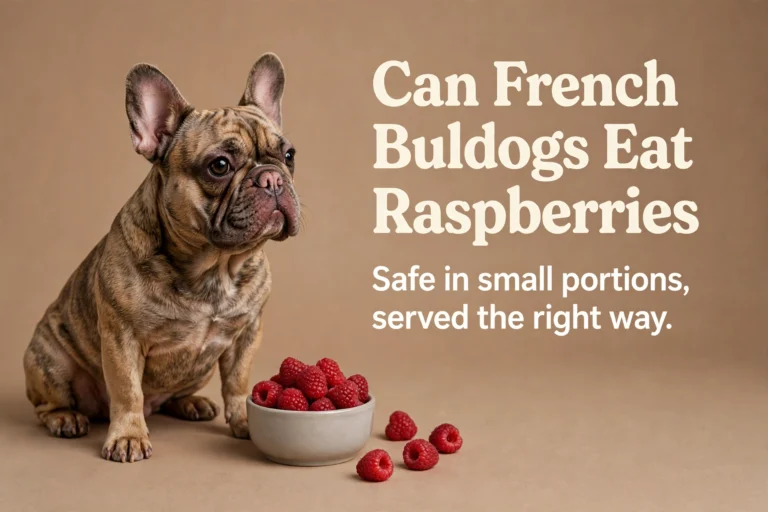
If you have ever watched your Frenchie stare at your breakfast bowl, you know the question comes fast: can French bulldogs eat raspberries? The short answer is yes. Fresh, plain raspberries are safe when you keep the portion small and serve them the right way. A few berries make a sweet, low calorie treat. A…
If your dog just stole a pretzel off the couch, you probably want one clear answer fast. The short version is this: a plain pretzel is not poisonous to dogs, but pretzels are still a poor snack choice, and some flavored kinds can be genuinely dangerous. Salt is the main problem, and a few hidden…
Yes, dogs can eat strawberry fruit without worry, as long as it is fresh, washed, and given in small amounts. Strawberries are not toxic to dogs. They are low in calories and carry vitamin C, fiber, and antioxidants. Keep scrolling for portions by dog size, safe prep steps, and the strawberry products to avoid. Can…