You walk into the room and your dog is licking bright blue crumbs off the floor while your child holds an empty yellow tub. Your stomach drops, and the first question in your head is simple: your dog ate play doh, so is your dog in real danger? A small bite of store bought Play-Doh is rarely a crisis, because the product is labelled non-toxic and its salt content is low. Homemade play dough is a different story, and a big helping of either kind can cause real trouble. This guide covers the ingredients, the salt math by dog size, the symptoms, the first steps, and the mistakes to avoid. Every number here comes from a published vet source, and your vet decides what your dog needs.
A Note on Health Advice
Play-Doh is a craft product, not a medicine, so there is no approved dose and no label that tells you how much is safe for a dog. This article gives general background only, and it is not a replacement for your vet. If your dog ate a large amount, if the dough was homemade, or if your dog shows any warning sign in this guide, call your vet right away, or an emergency vet clinic if your own vet cannot be reached. Do not try to treat salt poisoning at home. The salt numbers here describe what published sources report, and they are here so you can have an informed talk with your vet, not so you can work out a safe amount on your own.
The Short Answer: Is Play-Doh Dangerous for Dogs
For most dogs, a bite or two of store bought Play-Doh causes little more than a strange taste and perhaps a soft stool, because the maker labels it non-toxic. That label is not a promise that a dog can eat it freely. A dog that eats a whole tub, several tubs, or a batch of homemade dough can take in enough salt to become seriously ill. The real divide is between the two kinds of dough. Store bought Play-Doh has a modest amount of salt, so it usually takes a large amount to cause a problem. Homemade play dough, often called salt dough, can be one third salt by weight, and even a small ball of it can push a small dog into salt poisoning. A dog that chews through the plastic tub adds a second danger, because sharp plastic can cut or block the gut. So the answer depends on three things: which kind of dough it was, how much your dog ate, and how big your dog is. If you are unsure about any of those three, call your vet and let them judge.
What Is Actually in Play-Doh: Store Bought vs Homemade
Play-Doh is a modelling compound made from water, salt, and wheat flour, with borax, mineral oil, colorants, and fragrance added in. You can read more about the product on the Wikipedia page for Play-Doh, which explains its history and its makeup. The salt keeps the dough soft and stops mould, the flour gives it body, and the mineral oil keeps it from drying out. In a small bite, none of these is a poison for a dog, though a dog with a wheat allergy can still react to the flour. A scented tub is not more toxic than a plain one, though its smell can tempt a dog to eat more.
Homemade play dough looks similar on the table, but its recipe is very different. A typical homemade recipe calls for one cup of flour, half a cup of salt, half a cup of warm water, and a tablespoon of oil, with food colouring added for fun. That works out to salt making up about a third of the dry ingredients, which is an enormous amount for a dog. Some recipes also add cream of tartar, which brings its own risk, covered in its own section below. Because the two doughs look alike out of the tub, the first thing to work out is which kind it was. Check the tub, ask your child, or look at the recipe card. That one fact changes everything your vet will tell you next.
The Salt Math: How Much Play Dough Turns Dangerous by Dog Size
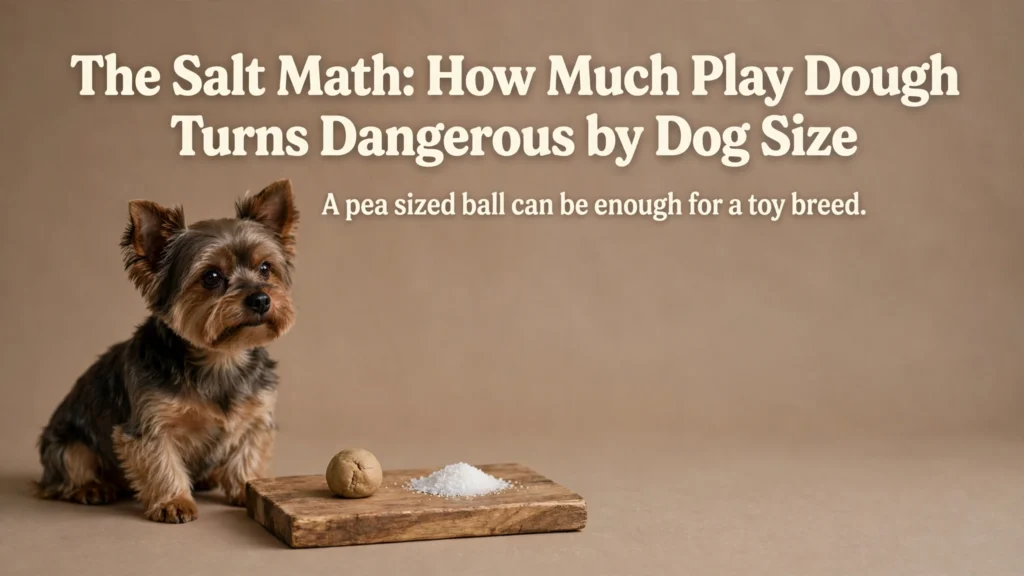
Salt is the danger in play dough, and the danger grows as the dog shrinks. The American Kennel Club notes that salt toxicosis can occur when a dog eats as little as 2 to 3 grams of sodium chloride for every kilogram of body weight, and the lethal dose sits near 4 grams per kilogram. The American College of Veterinary Pharmacists gives a matching figure for homemade play dough: as little as 1.9 grams of dough per kilogram of body weight can be toxic, and a tablespoon of homemade dough can hold around 8 grams of salt. A small dog needs only a small ball of homemade dough to reach a toxic amount, while a large dog would need to eat far more. To picture the salt load: a 30 pound dog needs only about 100 mg of sodium in a whole day, while a single ounce of homemade salt dough can hold over 1,000 mg, ten times the daily amount in one mouthful.
The table below uses the published figures from the American College of Veterinary Pharmacists to show the approximate amount of homemade play dough at which toxicity has been reported, by dog size. Treat it as background for your vet call, not as a safe limit, because recipes vary and your vet judges the real risk from the recipe, the amount, and your dog.
Dog size
Weight
Homemade play dough amount linked to toxicity
X-Small (Yorkie, Chihuahua)
1 to 10 pounds
More than about 1 gram
Small (Pug, Boston Terrier, Poodle)
11 to 25 pounds
More than about 9 grams
Medium (Beagle, Scottish Terrier)
26 to 40 pounds
More than about 22 grams
Large (Boxer, Cocker Spaniel)
41 to 70 pounds
More than about 35 grams
X-Large (Retriever, German Shepherd)
71 to 90 pounds
More than about 61 grams
XX-Large (Great Dane, St. Bernard)
91 to 110 pounds
More than about 79 grams
A gram is roughly the size of a pea, so a toy breed that swallows one small ball of homemade dough can already be in the danger zone. For store bought Play-Doh, the salt is far lower, so a dog usually has to eat a large quantity before salt becomes the main worry. That is why vets treat homemade dough as an emergency and store bought dough as a watch and wait case.
The Hidden Second Danger: Cream of Tartar and the Kidneys
Salt is not the only ingredient that can hurt a dog, and this is the detail most quick guides skip. Many homemade play dough recipes call for cream of tartar, and PetMD warns that cream of tartar holds some of the same chemical compounds as grapes, so eating too much of it can lead to kidney failure in dogs. Grapes are a known kidney toxin for dogs, and the shared compound is tartaric acid. Store bought Play-Doh does not usually contain cream of tartar, which is one more reason the two doughs are not equal in risk. A homemade batch with cream of tartar carries two dangers at once: the salt can poison the blood, and the tartaric acid can injure the kidneys. Kidney damage may not show up on the first day. If your dog ate homemade dough that lists cream of tartar, tell your vet about that ingredient by name, so the vet can check kidney values in the bloodwork instead of watching salt alone, and may test them again a day or two later.
Symptoms and Their Timeline: What Shows Up First
Salt poisoning does not always announce itself at once, and the timing tells you a lot about how serious it is. The American College of Veterinary Pharmacists reports that signs of homemade play dough toxicity have appeared within 3 hours of eating it, and vomiting is most often the first sign. A review of 14 dogs that ate homemade play dough, published in the Journal of Veterinary Emergency and Critical Care, found that 12 of the 14 showed signs. Vomiting appeared in 9 of the 14, about 64 percent, while heavy thirst and seizures each appeared in 4 of the 14, about 29 percent.
The early signs are vomiting, diarrhoea, a smaller appetite, tiredness, and heavy thirst. If the salt load is larger, the signs turn neurological: wobbling, a lack of coordination, muscle tremors, confusion, and seizures. In the worst cases a dog can fall into a coma. These later signs can appear within a few hours, and they can take up to 12 hours to show in some dogs, so a dog that looks fine at bedtime can still be in trouble by morning. That is why the watch period after a big ingestion is at least 24 hours. A separate set of signs points to a blockage rather than salt poisoning: repeated vomiting, belly pain or swelling, a loss of appetite, and straining to pass stool. Blockage signs can appear hours to days after the dough was eaten, so keep watching the stool for 24 to 48 hours. Any one of the serious signs, vomiting that will not stop, tremors, wobbling, confusion, a seizure, or a swollen belly, means your dog needs a vet now, not tomorrow.
The First 10 Minutes: What to Do Right Now
The first minutes after you find your dog eating Play-Doh set the tone for everything that follows, and a calm, quick routine helps more than panic. Step one is to take away what is left. Pick up every piece of dough, close the tubs, and move your dog to another room so the eating stops. Step two is to work out what your dog ate. Check the tub label or the recipe card, note whether it was store bought or homemade, and estimate how much is missing. A photo of the label and the recipe helps the vet a lot. Step three is to note the time and your dog’s weight, and to look for symptoms right now. Step four is to call your vet, or the ASPCA Animal Poison Control line at 888-426-4435, or the Pet Poison Helpline at 855-764-7661. The Pet Poison Helpline charges 85 dollars per incident, and that fee covers as many calls as needed about that incident. A fee may also apply for the ASPCA line. Have the label, the recipe, the amount eaten, your dog’s weight, and the time of eating ready before you dial. Do not wait for symptoms to appear before you call, because the vet can judge the risk from the amount and the recipe while your dog still looks well. If the dough was store bought and your dog ate only a bite or two, the vet may tell you to watch at home and offer small sips of fresh water. If the dough was homemade, or your dog ate a large amount, or your dog is very small, the vet will usually want to see the dog at once.
What Never to Do After Your Dog Eats Play-Doh
Two common instincts can make things worse, and both deserve their own warning. First, never try to make your dog vomit at home. Forcing vomiting can cause the dough to come back up into the lungs, and that can lead to aspiration pneumonia, a serious and sometimes fatal lung infection. Your vet may decide to induce vomiting in the clinic, where it can be done safely, but that choice belongs to the vet, who weighs the amount eaten, the time since eating, and your dog’s condition. Second, never let your dog gulp down large amounts of water. It feels kind to offer a big bowl after a salty meal, but a dog with salt poisoning needs fluids given slowly and carefully under a vet’s watch. Too much water too fast can make the salt imbalance worse and can push the brain toward swelling. Offer small sips instead, and let the vet manage the fluids if your dog needs them. A third mistake is to wait and see when the dough was homemade, because salt poisoning can turn severe within hours. Do not give your dog human medicines, salt water, or home remedies either, since none of these helps. If you are unsure what to do, call your vet or a poison control line and follow what they say.
Scented, Glitter, and Play-Doh Plus: Do the Varieties Change the Risk
Play-Doh comes in more forms than the plain coloured tubs, and owners often ask whether the fancy kinds are worse. Scented Play-Doh uses fragrance oils to smell like fruit or sweets, and the scent can make a dog more likely to eat it, but the scent itself does not add a new poison. The salt and flour inside are the same. Glitter Play-Doh adds fine glitter flakes, and those flakes can irritate the mouth and gut, yet they are not a poison in the amounts a dog would eat. Play-Doh Plus is a softer, lighter version, and its recipe is similar to the standard kind, so the risk is about the same. Modelling clay sold under other brand names is a different matter, because some clays hold other chemicals, and a clay that hardens in air may set inside the gut. If your dog ate a modelling product that is not Play-Doh, read the label and tell your vet the brand name. One variety that does change the answer is a dry, crumbly tub, or a baked salt dough ornament. Dried dough is harder and less likely to break down in the gut, and a baked ornament is a solid lump of salt and flour, so treat either one like homemade dough: call your vet at once.
Puppies, Small Dogs, and Dogs With Health Problems
Size is the single biggest factor in how dangerous play dough is, and the American Kennel Club makes the point plainly: a smaller dog needs a smaller amount of a toxic substance to become ill than a larger animal. A puppy or a toy breed can reach a toxic salt level from a ball of homemade dough no bigger than a pea, while a large dog might eat the same ball and show nothing at all. Puppies carry extra risk for three reasons. They weigh less, they explore the world with their mouths, and their bodies handle salt and fluid shifts less well than an adult dog. A puppy that eats homemade dough should be treated as an emergency even if the amount looks small. Dogs with kidney disease, heart disease, or high blood pressure are also at higher risk, because their bodies already struggle to manage salt and fluid. A dog with kidney disease cannot clear extra salt well, and a dog with heart disease can be pushed toward fluid overload by a salty meal. Dogs that take medicines that affect salt and water balance need the same care. If your dog has any of these conditions, tell your vet about it when you call, even if the amount eaten looks small. Senior dogs deserve the same extra care, because aging kidneys clear salt more slowly.
What the Vet Will Do at the Clinic
Knowing what happens at the clinic can take some of the fear out of the visit. The vet will start by asking what your dog ate, how much, and when, and whether the dough was store bought or homemade. Bring the tub, the label, or the recipe card if you can, because the salt content is the key number. The vet will then check your dog’s vital signs and look for vomiting, wobbling, tremors, and signs of dehydration. A blood test will measure the sodium level, which drives the treatment plan, and the vet may also check kidney values, especially if the dough held cream of tartar. If the salt level is high, the vet will give intravenous fluids slowly and carefully, because bringing the sodium level down too quickly can make brain swelling worse. The vet lowers it in small steps over many hours, checking the blood again and again. Dogs with seizures may need anti-seizure medicine, and dogs with a suspected blockage will get an X-ray or an ultrasound to find where the dough or plastic is sitting. A blockage that will not move may need an endoscope to pull it out, or surgery to remove it. Most dogs with salt poisoning need a couple of days in the hospital to recover fully, and dogs that get care early, before seizures start, have the best chance of a full recovery.
The Plastic Tub Problem: When the Container Is the Danger
Sometimes the dough is not the worst part of what your dog ate. Play-Doh comes in yellow plastic tubs with coloured lids, and a determined dog can chew straight through one. Sharp pieces of plastic can cut the mouth, the throat, the stomach, and the gut, and larger pieces can block the intestines. A blockage is a serious problem on its own, and it needs a vet even when the dough inside was harmless. If your dog tends to swallow things that are not food, our guide to a dog that ate cardboard walks through the same blockage warning signs, and it is worth reading so you know what to watch for. The signs to watch for are repeated vomiting, belly pain or swelling, a loss of appetite, tiredness, and straining to pass stool, or passing only small amounts of diarrhoea. If you see plastic pieces in the vomit or the stool, tell your vet. Keep the broken tub so the vet can see how much plastic is missing, and check the floor for any small pieces your dog may still be able to reach.
Keeping Play-Doh Away From Your Dog
Prevention is easier than treatment, and a few small habits can keep Play-Doh out of your dog’s reach for good. Store every tub in a closed cabinet or a high shelf, and use child safety locks on the doors if your dog has learned to nose them open. Dogs are good at getting into low drawers and open boxes, so a latched container beats a loose tub on a shelf. Supervise craft time closely when children are playing with dough, and teach them to pick up dropped pieces right away. A pet gate can keep your dog out of the play area while the children are busy. When craft time is over, put the dough away, and throw dried out or unused dough into a sealed bin your dog cannot open. Air dry clay, baking soda dough, and cornstarch dough made without salt are gentler choices for a home with a dog, though no craft material is meant to be eaten, so supervision still matters. Keep other high salt items out of reach too, including paintballs, de-icing salt, and homemade salt dough ornaments.
Conclusion: The Bottom Line if Your Dog Ate Play-Doh
A dog ate play doh is a scare most owners will face at some point, and the answer is calmer than the panic suggests. A small bite of store bought Play-Doh is rarely dangerous, and most dogs that eat a little of it need nothing more than watching at home and a call to the vet for reassurance. The danger grows with the amount, with the salt, and with the size of the dog. Homemade play dough is the real emergency, because its salt can poison a small dog from a single small ball, and cream of tartar can add kidney injury on top. A calm plan, a vet you trust, and a craft cupboard with a lock on it are worth more than any remedy from the kitchen. The safety rules are simple and worth repeating: work out which kind of dough it was and how much is missing, call your vet or a poison control line before symptoms appear, never try to make your dog vomit, and never let your dog gulp down large amounts of water. If your dog shows vomiting that will not stop, tremors, wobbling, confusion, or a seizure, go to the vet at once.
Frequently Asked Questions About Dogs Eating Play-Doh
Is Play-Doh toxic to dogs?
Store bought Play-Doh is labelled non-toxic, so a small bite is not expected to poison a dog. It can still cause vomiting, diarrhoea, or a blockage in large amounts. Homemade play dough is a different matter, because its high salt content can cause salt poisoning, which can be life threatening.
How much Play-Doh is dangerous for a dog?
It depends on the kind of dough and the size of the dog. The American College of Veterinary Pharmacists reports that as little as 1.9 grams of homemade play dough per kilogram of body weight can be toxic, about 1 gram for a dog under 10 pounds. Store bought Play-Doh holds far less salt, so it usually takes a large amount to cause a problem. Your vet judges the risk from the recipe, the amount, and your dog’s weight.
My dog ate a small bite of Play-Doh. What should I do?
Take away what is left, check whether it was store bought or homemade, and call your vet. For a small bite of store bought Play-Doh, the vet may tell you to watch at home, offer small sips of water, and look out for vomiting or a loss of appetite. If the dough was homemade, call your vet at once, whatever the amount.
What are the signs of salt poisoning in dogs?
The early signs are vomiting, diarrhoea, a smaller appetite, tiredness, heavy thirst, and extra urination. More serious signs are wobbling, a lack of coordination, muscle tremors, confusion, and seizures. Signs have been reported within 3 hours of eating homemade play dough, and they can take up to 12 hours to appear.
Can I make my dog vomit after eating Play-Doh?
No, never try to make your dog vomit at home. Forcing vomiting can push dough into the lungs and cause aspiration pneumonia, a serious lung infection. Your vet may decide to induce vomiting in the clinic, where it can be done safely. That choice belongs to the vet.
How long does it take for Play-Doh to pass through a dog?
In most cases, Play-Doh passes through the digestive tract within 24 to 48 hours. Watch your dog’s stool during that time, and call your vet if you see repeated vomiting, belly pain, straining to pass stool, or no stool at all, because those signs can mean a blockage.
Is homemade play dough more dangerous than store bought Play-Doh?
Yes, far more dangerous. A typical homemade recipe is about one third salt, while store bought Play-Doh holds a modest amount. A single ounce of homemade salt dough can hold over 1,000 mg of sodium, about ten times the daily amount for a 30 pound dog. It can also hold cream of tartar, which can injure the kidneys.
Can dogs eat Play-Doh with glitter or scent?
Scented Play-Doh is not more toxic than plain Play-Doh, though the smell can tempt a dog to eat more of it. Glitter Play-Doh can irritate the mouth and gut, but the glitter is not a poison in the amounts a dog would eat. The salt inside is the same, so the same rules apply: a small bite is usually fine, a large amount needs a vet call.
Bella Barker is a pet food safety writer with 10+ years of experience. She researches what dogs and cats can (and can't) eat and turns it into simple, practical guides for everyday pet parents. 🐶🐱
If your dog ate cardboard, take a breath. Most dogs are fine after eating a small amount of it. Plain cardboard is not toxic, and small soft pieces usually pass through the digestive system within a day or two. The real risk is a blockage, and that risk grows with the amount eaten, the size…
A cat not eating is one of the most worrying things a cat owner can face. Most cats eat at the same times each day, so a broken pattern naturally raises the question of whether to wait, try a new food, or call the vet. The honest answer is that appetite loss is a symptom,…
Baking soda sits in almost every kitchen. You may use it to bake, to clean a sink, or to freshen a carpet. If you share your home with a cat, one question matters more than the rest: is baking soda safe for cats when they walk through it, lick it off a paw, or get…
After PineSol, the next “natural” cleaner most cat owners reach for is the big bottle of white vinegar under the sink. It is cheap, it has no perfume, and it feels safer than bleach or sprays. So is white vinegar safe for cats, or is that feeling wrong? The honest answer sits in the middle….
Your senior cat will probably never limp the way a sore dog does. She will simply stop doing the small things that used to fill her day. The jump to the windowsill becomes a pause, then a walk away. The stairs become a slow climb, one paw at a time. The coat over her hips…
It is confusing to watch your cat finish meals and still get thinner. Food is going in, so weight should stay steady. When it does not, the problem is usually not the amount of food in the bowl. It is what the body does with that food after it is eaten. A cat losing weight…