Baking soda sits in almost every kitchen. You may use it to bake, to clean a sink, or to freshen a carpet. If you share your home with a cat, one question matters more than the rest: is baking soda safe for cats when they walk through it, lick it off a paw, or get into the box?
The short answer is that baking soda is not a poison in the way rat poison or antifreeze is a poison. A tiny lick is unlikely to hurt a healthy adult cat. But baking soda is also not harmless. In larger amounts it can upset the stomach, throw the body’s salts out of balance, and in serious cases cause tremors or seizures. The line between fine and dangerous is smaller than most owners expect, because cats are small and because cats groom.
This guide gives you that line. You will learn how much is dangerous, how cats actually come into contact with baking soda, which warning signs need a vet right away, and which everyday uses are safe to keep and which ones to drop.
The Short Answer: Not a Poison, But Not Safe Either
Baking soda is the common name for sodium bicarbonate, a white powder that is a base, which means it reacts with acids. That reaction is why it fizzes with vinegar and why it calms smells. Cat urine is acidic, so baking soda neutralizes the smell instead of covering it up.
That same chemistry is the problem inside a cat. Sodium bicarbonate is a salt. When a cat swallows a large amount, the sodium load rises fast and the blood becomes too alkaline. The body tries to correct this, and that correction is what causes the symptoms. So the safety question is never just “is this product toxic?” It is always “how much did the cat take in, and how big is the cat?”
A cat that licks a trace off a clean floor is in a very different place from a cat that eats from an open box. Keep that difference in mind through the whole article, because it decides almost every rule that follows.
Why a Small Cat Is at More Risk Than You Think
Three facts stack up against cats here. First, body size. An average adult cat weighs around 4 to 5 kilograms, roughly the size of a small bag of flour. A dose that would barely register in a person or a large dog is a much bigger dose per kilogram in a cat.
Second, grooming. Cats clean themselves with their tongues many times a day. Anything that lands on the fur or the paws ends up in the mouth sooner or later. This is the part most guides underplay. Baking soda does not need to be eaten from a bowl to be swallowed. A cat that walks across a freshly sprinkled carpet, then sits down for a wash, has eaten it.
Third, age and health. Kittens, senior cats, and cats with kidney disease or an existing salt imbalance are at higher risk. Their bodies have less room to correct a sudden sodium load. If your cat falls into one of these groups, treat every rule in this article as stricter than written.
How Much Baking Soda Is Dangerous for a Cat?
There is no single agreed number, and you should be wary of any article that gives you one without saying so. Published estimates differ. Daily Paws reports that 1 to 2 teaspoons can be dangerous for a cat. Catster puts the toxicity estimate higher, at around 2 tablespoons for an average 8.8 pound cat. Fully Healthy cites a range of 0.5 to 1 gram per kilogram of body weight before symptoms appear.
What all of these agree on is the shape of the risk. A trace, like the dust left after vacuuming, is very unlikely to cause harm. A teaspoon or more is the zone where you should call your vet even if your cat looks fine. A tablespoon or more is an emergency, not a wait and see situation.
The honest way to use these numbers is as a rough scale, not a safe allowance. There is no amount of baking soda you should deliberately feed a cat. The numbers exist so you can judge an accident, not plan a serving.
The Three Ways Cats Actually Meet Baking Soda
Most articles list uses of baking soda. It is more useful to list the three routes by which it reaches a cat, because the route decides the risk.
The first route is eating it directly. This is the open box in a low cupboard, the spill on the kitchen floor, or the homemade play dough left on a table. Direct eating gives the largest dose in the shortest time, and it is the route behind most serious cases.
The second route is paws and grooming. The cat walks through powder sprinkled on a carpet, a rug, or a litter box, and then licks its paws clean. The dose is smaller, but it is also easy to miss. You may never see it happen. This is why the “keep the cat out of the room until the powder is fully vacuumed up” rule matters so much.
The third route is dust in the air. Baking soda is a fine powder. Shaking it out of a box near a cat, or pouring it into a litter box while the cat is standing beside you, sends a cloud into the air. Cats have sensitive noses and airways, and breathing in powder can cause sneezing and irritation even when nothing is swallowed. Keep the cat out of the room while you sprinkle, and let the dust settle before the cat returns.
Warning Signs: From an Upset Stomach to a Vet Emergency
Symptoms usually start in the stomach. Vomiting is often the first sign, followed by drooling, diarrhea, gas, and stomach pain. A cat that has taken in a moderate amount may drink much more water than usual, seem tired, or go quiet and withdrawn.
Serious signs mean the salt balance has gone wrong. Watch for weakness, wobbliness, muscle twitching or tremors, disorientation, rapid or troubled breathing, and seizures. These are emergency signs. Do not wait to see if they pass. Get to a vet or an emergency clinic right away.
Mild signs after a tiny exposure, like one vomit and then normal behavior, still deserve a phone call to your vet. You do not need to rush to the clinic for every lick, but a vet can tell you what to watch for over the next few hours, and that call costs nothing.
What to Do in the First 30 Minutes After Your Cat Eats Baking Soda
Stay calm and work through these steps in order.
First, figure out how much is gone. Look at the box, the spill, or the container. A missing teaspoon and a missing quarter of a box are very different calls to make, and your vet will ask.
Second, move the cat away from the source and give fresh water. Water helps dilute what was swallowed. Do not try to make your cat vomit. Forcing vomiting can cause more harm, and cats in particular should never be given home emetics like hydrogen peroxide.
Third, call your vet or a pet poison line right away, even if your cat looks fine. Tell them the amount, your cat’s weight and age, and the time it happened. If your cat is showing serious signs, skip the phone call and go straight to the clinic.
Fourth, watch your cat closely for the next few hours. Keep the cat indoors, in a quiet room, with water nearby. Note any vomiting, wobbliness, or change in behavior, and report it to your vet.
If your cat only licked a trace off a floor, fresh water and watching are usually enough. But when in doubt, the phone call is always the right move.
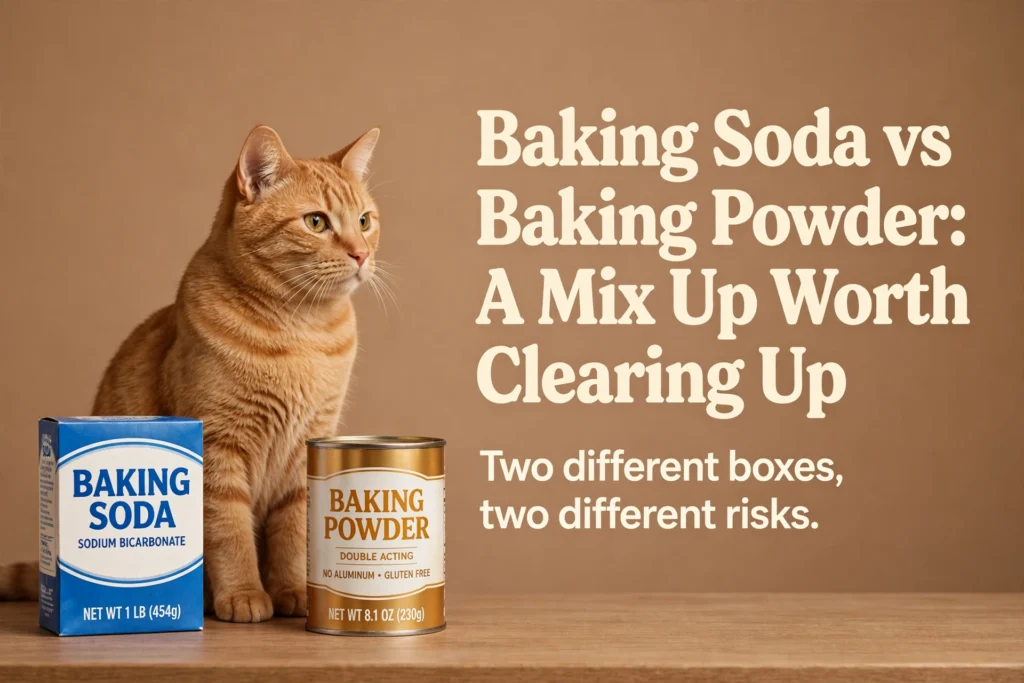
Baking Soda vs Baking Powder: A Mix Up Worth Clearing Up
Baking soda and baking powder sit side by side in many kitchens, and owners mix them up. They are not the same product, and the mix up matters.
Baking soda is pure sodium bicarbonate. Baking powder is sodium bicarbonate mixed with an acid and a starch, so it is weaker per spoonful but still a sodium load. It also often contains extra ingredients that are not good for cats. The safety rules in this article apply to both, but baking powder should be treated as a separate product to keep away, not as a safer version of baking soda.
If your cat gets into either one, tell your vet which product it was. The box label helps, so take a photo of it before you call.
The Litter Box Question: Under the Litter or Not at All
The litter box is the most common reason owners ask about baking soda. The honest answer is that it can be used, but only in one way.
If you use it, put a thin layer underneath the litter, not on top of it. Mixed under the litter, the powder stays out of direct contact with paws and is less likely to be kicked up as dust. A small sprinkle is enough. More powder does not mean better smell control, it just means more dust and more contact.
Never pour a thick layer on top of the litter where your cat steps and digs. Never use it in a box used by a kitten under two months old, since young kittens are more likely to taste litter. And if your cat is a paw licker, or if you notice sneezing after you add it, stop using it entirely. There are safer ways to handle litter smell, covered below.
Some litters come with baking soda already mixed in by the maker. These are usually less dusty and lower in dose than adding your own, and most cats do fine with them. If your cat starts sneezing or licking paws more after a litter change, the litter itself may be the cause, with or without baking soda in it.
Four Uses to Skip Around Cats
Some popular baking soda uses are not worth the risk for a cat home, because the grooming route turns a small exposure into a swallowed dose.
Do not put baking soda on your cat’s fur. It is sometimes suggested as a dry shampoo or a flea remedy. It does not kill fleas well, and your cat will lick it off. The same goes for baking soda baths and skin pastes for rashes. A cat will groom the treated area, and a skin problem plus a stomach problem is worse than the skin problem alone.
Do not use baking soda as cat toothpaste. Cats cannot rinse and spit, so everything you brush onto the teeth gets swallowed. Pet toothpaste made for cats exists for this reason.
Do not sprinkle it on your cat’s bedding. Bedding touches fur for hours, and the residue ends up in the mouth during grooming. Wash bedding in hot water instead.
Do not use it for cat first aid. It does not clean wounds well, and it can irritate damaged skin. Warm water is the safer choice until a vet can see the cat.
Safer Ways to Handle Smells Without Baking Soda
If the reason you reached for baking soda is smell, you have better options. Scooping the litter box daily does more for smell than any powder. Washing the box itself with warm water and a mild unscented soap on a regular schedule keeps the plastic from holding odor.
For carpets, regular vacuuming and a prompt clean of accidents with warm water and a small amount of mild soap work well. Keep the cat out of the room until the area is fully dry. For laundry, washing bedding in hot water with your usual detergent is enough in most cases.
Diluted white vinegar and cats is another option many cat owners use, and it is worth knowing about because it is often paired with baking soda in cleaning advice. Vinegar dries without leaving a powder a cat can lick, which removes the grooming risk. Our guide to white vinegar and cats explains the safe dilution and the places to avoid it. Never mix baking soda and vinegar into a paste for use around cats, since the fizz is not cleaning better, it is just making a mess your cat can walk through.
A Note on Health Advice
This article is general information, not veterinary advice. Every cat is different, and factors like age, weight, kidney health, and medicines change the risk. If your cat has eaten baking soda, or if you are unsure about any product in your home, talk to your own veterinarian. If your cat is showing serious signs like seizures, tremors, or trouble breathing, treat it as an emergency and go to a vet clinic right away.
Conclusion: The Bottom Line on Baking Soda and Cats
Baking soda is not a poison in small traces, but it is not a safe product to be casual about around cats. A tiny lick off a clean floor is unlikely to cause harm. A teaspoon or more is a reason to call your vet. A tablespoon or more is an emergency. The grooming habit is what turns powder on floors, carpets, and bedding into something swallowed, so the safest rule is simple: keep the box closed and out of reach, keep the cat out of the room while you sprinkle and vacuum, and never put baking soda on the cat itself.
Used that way, baking soda can still do its job in your home. The powder stays where it belongs, and your cat stays out of the dose range where it causes harm.
Frequently Asked Questions About Baking Soda and Cats
Is baking soda safe for cats in small amounts?
A tiny lick, such as residue left on a floor after cleaning, is unlikely to harm a healthy adult cat. Larger amounts, starting around a teaspoon, can cause stomach upset and salt imbalance, so call your vet if your cat eats a measurable amount.
Can a cat die from eating baking soda?
Death is very unlikely from a small exposure, but large amounts can cause serious electrolyte imbalance and, in severe cases, seizures or breathing trouble that need emergency vet care. Any large ingestion should be treated as urgent, not watched at home.
What should I do if my cat licked baking soda off the floor?
Give fresh water, keep the cat away from the source, and watch for vomiting, drooling, or tiredness over the next few hours. If your cat ate more than a trace, or shows any symptoms, call your vet for advice.
Can I put baking soda in my cat’s litter box?
You can put a thin layer under the litter, not on top of it, so your cat does not step directly in it. Skip it entirely for kittens under two months old, for cats that lick their paws a lot, or if you notice sneezing after adding it.
Is baking soda safe to use on cat bedding or fur?
No. Cats groom themselves, so powder on fur or bedding ends up swallowed. Do not use baking soda as a dry shampoo, flea remedy, or skin treatment for cats. Wash bedding in hot water instead.
What is the difference between baking soda and baking powder for cats?
Baking soda is pure sodium bicarbonate. Baking powder is sodium bicarbonate mixed with an acid and a starch, plus sometimes other ingredients. Both are sodium loads for a cat, so keep both out of reach and tell your vet which one your cat got into.
Can I use baking soda to clean up after my cat?
Yes, on surfaces like floors and carpets, as long as you keep your cat out of the room while the powder sits and vacuum it up fully before letting the cat back in. Never leave a thick layer where a cat can walk through it.
What are safer alternatives to baking soda for cat smells?
Daily litter scooping, washing the litter box with warm water and mild soap, regular vacuuming, and hot water laundry do most of the work. Diluted white vinegar is another option that dries without leaving a powder a cat can lick.
Bella Barker is a pet food safety writer with 10+ years of experience. She researches what dogs and cats can (and can't) eat and turns it into simple, practical guides for everyday pet parents. 🐶🐱
If you have noticed your cat at the water bowl far more often than usual, it is natural to worry. Cats are not big drinkers by nature, so a clear change in drinking habits is worth paying attention to. In most cases the reason turns out to be simple, like a change of food or…
If your cat licked aloe vera gel off your hand, a tube, or a plant leaf, you probably have one question: is my cat going to be okay? The short answer is that a single small lick is rarely an emergency, but aloe vera is still a toxic plant for cats, and the details matter….
If your dog will not stop scratching, the allergy tablets in your own medicine cabinet can look like an easy fix. Cetirizine, sold under the brand name Zyrtec, is one of the first names owners search for, and the question can dogs have cetirizine has a short answer: yes for many dogs, when a vet…
If your dog drools, pants, and vomits on every car ride, the little box of Dramamine in your own medicine cabinet can look like a simple fix. Dramamine is the brand name for dimenhydrinate, a human motion sickness tablet, and vets do use it for dogs that get sick while traveling. The question of a…
A cat not eating is one of the most worrying things a cat owner can face. Most cats eat at the same times each day, so a broken pattern naturally raises the question of whether to wait, try a new food, or call the vet. The honest answer is that appetite loss is a symptom,…
If your cat has started drinking more water than usual, you are asking the right questions. Chronic kidney disease is the most common long-term condition in senior cats, and learning about cat kidney disease early signs and stages now gives you the best chance of catching problems while they are still manageable. The Short Answer…