Figs look like a healthy snack. They are soft, sweet, and full of fiber, so it is natural to wonder if your dog can share one. The short answer is yes, fresh ripe figs are safe for dogs in small amounts. But the form of the fig matters a lot. Dried figs, fig cookies, fig jam, and every part of the fig tree carry very different risks. This guide covers the safe portion for your dog’s size, the sugar math behind it, the parts of the plant that are toxic, and the warning signs to watch for after your dog eats figs.
The Short Answer: Yes, Fresh Figs in Small Amounts
Fresh ripe figs are not toxic to dogs. The American Kennel Club lists figs among the fruits dogs can eat when they are served plain and in small amounts. A healthy adult dog can enjoy a small piece of fresh fig as an occasional treat with no problem in most cases.
That does not make figs a health food for dogs. Figs are one of the sweetest fresh fruits you can share. A single medium fresh fig holds about 37 calories and around 8 grams of sugar. For a small dog, that is a real share of the daily treat budget. Treat figs as a rare extra, not a daily snack.
The safe part is only the ripe fruit. The leaves, stems, bark, milky sap, and unripe fruit of the fig tree are toxic to dogs. The ASPCA lists fig plants in the Ficus family as toxic, and the problem compounds are ficin and a psoralen called ficusin. Keep those two facts apart and the whole topic becomes simple: ripe fruit in tiny amounts is fine, the plant is not.
If your dog has diabetes, is overweight, has a sensitive stomach, or is still a puppy, check with your vet before offering figs. The rest of this guide explains why.
Fresh Figs vs Dried Figs: Why the Form Changes Everything
Fresh figs and dried figs side by side: dried figs pack triple the sugar.
Most dogs never meet a fresh fig. They meet a dried fig from a trail mix bag, a Fig Newton from a lunchbox, or a fig bar from a pantry shelf. Each form is a different answer.
Fresh figs are about 80 percent water. Drying removes that water and packs the sugar and calories into a much smaller bite. Per 100 grams, fresh figs hold about 74 calories and 16 grams of sugar. The same weight of dried figs holds about 249 calories and 47 grams of sugar. That is roughly three times the sugar and calories in every bite.
A single dried fig weighs only 8 to 10 grams, yet it carries about 5 grams of sugar, close to what a whole small fresh fig carries. The trouble is that dried figs are small, chewy, and easy to over serve. Three or four dried figs disappear in seconds, and the concentrated fiber can cause loose stools even in a large dog.
Dried figs also bring two extra risks. Some brands add sugar or syrup, and some are treated with sulfur dioxide as a preservative, which can bother sensitive dogs. Dried fruit mixes often hide raisins or currants next to the figs, and raisins can cause sudden kidney injury in dogs even in small amounts. If your dog eats from a dried fruit mix, check the bag at once and call your vet if raisins are listed.
How Many Figs Can a Dog Eat? Portions by Dog Size
Vets use one simple rule for all treats: treats should stay under 10 percent of your dog’s daily calories. Figs are sugary, so aim well under that ceiling. The amounts below are maximums per serving, offered once or twice a week, not every day.
Dog size
Fresh fig per serving
How often
Extra small, under 10 lb
Less than a quarter of a fig
Once a week at most
Small, 10 to 25 lb
About a quarter of a fig
Once or twice a week
Medium, 25 to 60 lb
About half a fig
Once or twice a week
Large, 60 to 100 lb
About one small fig
Once or twice a week
Giant, over 100 lb
One to two small figs
Once or twice a week
The 10 percent rule makes the math clear. A 20 pound dog eating about 400 calories a day has a treat budget of about 40 calories. Half a fresh fig is about 18 calories, which fits. A whole fig at 37 calories would use nearly the entire budget on one bite. A 60 pound dog eating about 1,000 calories a day has a treat budget near 100 calories, so one small fig fits with room to spare.
Start with one small piece the first time and watch your dog for 24 hours. If the stool stays normal and there is no vomiting or itching, the portion suits your dog. Puppies, seniors, and dogs with diabetes, pancreatitis, or a sensitive stomach should get a vet’s okay first, because their safe portion may be zero.
What Is Inside a Fig? Nutrition Facts That Matter for Dogs
Figs come from the Ficus carica tree, a fruit tree grown for thousands of years around the Mediterranean. The ripe fruit is soft, sweet, and full of tiny seeds. Here is what a dog actually gets from a fig, per 100 grams of fresh fruit, based on USDA FoodData Central values.
Fresh figs hold about 74 calories, 16 grams of natural sugar, 2.9 grams of dietary fiber, 232 milligrams of potassium, 35 milligrams of calcium, and small amounts of vitamin B6 and vitamin K. A medium fresh fig of about 50 grams gives roughly half those numbers: about 37 calories, 8 grams of sugar, 1.4 grams of fiber, and 116 milligrams of potassium.
None of this makes figs a food your dog needs. A complete commercial dog food already covers fiber, potassium, calcium, and vitamins in the right amounts. The nutrients in a quarter or half fig are a small bonus, not a reason to feed figs. The sugar is the real story. At 16 grams of sugar per 100 grams, figs are sweeter than apples, blueberries, and watermelon, which is why the portion stays small.
Real Benefits of Figs for Dogs
Figs do offer a few genuine benefits when the portion stays small. The soluble fiber can help a dog with mild constipation, because it adds bulk and draws water into the stool. The prebiotic effect of pectin feeds helpful gut bacteria such as Lactobacillus and Bifidobacterium, which support a healthy gut.
Potassium is another real plus. A medium fig adds about 116 milligrams of potassium, which helps muscles and nerves work normally. Dogs that lose extra potassium through heavy urination may get a small lift from it, though a balanced diet already covers the need.
For active dogs, the natural glucose and fructose in figs give quick energy. A small piece of fresh fig can work as a fast energy treat during a long walk or a training session. That benefit does not apply to a couch potato dog, for whom the sugar is a liability instead.
Figs also work well as enrichment. Mash a teaspoon of ripe fig into plain canned food and spread it thin on a lick mat, and a tiny portion lasts much longer. Your dog gets the taste and the fun without the sugar load of a whole fruit.
If your dog loves figs, great. If your dog sniffs and walks away, nothing is missing from the diet. Lower sugar fruits are easier everyday choices, and pineapple is another fruit dogs can enjoy in small amounts, as our guide to can dogs eat pineapple explains. Blueberries, apple slices without the core, and seedless watermelon are all lighter options than figs for a regular fruit treat.
The Fig Tree Danger: Leaves, Sap, and Unripe Fruit
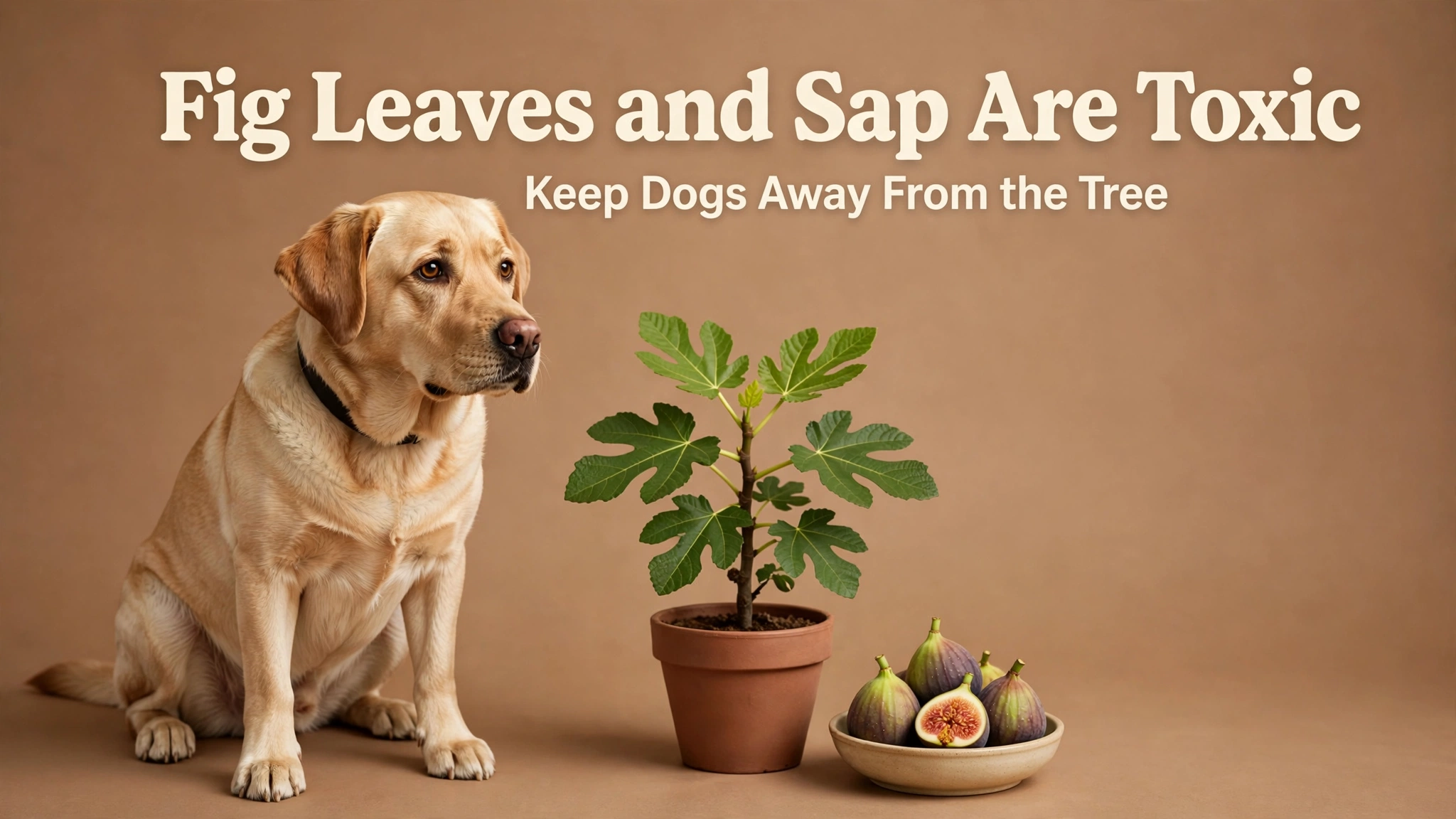
A fig plant with leaves and fresh figs: the leaves and sap are toxic to dogs.
This is the part of the topic that causes the most confusion, so here it is plainly. The ripe fruit is safe. The tree is not. Every other part of the fig plant is toxic to dogs.
The ASPCA lists fig plants in the Ficus family as toxic to dogs, cats, and horses. The toxic principles are ficin, a protein digesting enzyme, and ficusin, a psoralen compound. Both live in the leaves, stems, bark, and the milky white sap that oozes from cut stems and unripe fruit.
Ficin irritates the mouth, throat, and stomach lining on contact. A dog that chews a fig leaf may drool, paw at its mouth, lick its lips, vomit, or refuse food. Psoralens make the skin extra sensitive to sunlight, which can lead to redness, rash, and blistering on sun exposed skin. At higher doses, psoralens can also cause vomiting, diarrhea, and signs such as depression or wobbliness.
Unripe figs carry more of the milky sap than ripe ones, so never let your dog eat figs straight off the tree. A fig that still oozes white latex at the stem, feels hard, or tastes sour is unripe and should be skipped. Ripe fallen fruit is the same as store bought fruit once it is washed, but check it for stems and leaf bits first.
If your dog chews fig leaves or swallows sap, do not wait for symptoms to get worse. Rinse the mouth with plain water, wash any sap off the skin with mild soap, and call your vet. If your vet is closed, call ASPCA Animal Poison Control at 888-426-4435. Note that a fee may apply. Keep the plant away from your dog in the meantime. If you grow a fig tree, fence it off or train your dog to leave it alone.
Fig Newtons, Fig Jam, and Fig Bars: Why Processed Figs Are a No
Fig Newtons, fig bars, fig rolls, and fig jam are human foods, not fruit. They start with figs and then add sugar, refined flour, and fat until very little of the fruit’s benefit is left.
A Fig Newton is a soft cake shell around concentrated fig paste with added sugar and corn syrup. Two biscuits hold about 12 grams of added sugar. One biscuit is unlikely to poison a healthy medium or large dog, but several can cause vomiting or diarrhea, and the habit adds empty calories fast.
Fig bars and fig rolls are the same story under different names. Fig rolls are simply the British name for the same fig filled biscuit. Brands that call themselves whole grain or natural still carry a heavy sugar load. Store brand and gluten free versions are no better, and sugar free versions are the most dangerous of all, because they are the ones most likely to use xylitol.
Xylitol is the ingredient to fear. It can drop a dog’s blood sugar within an hour and cause liver failure at higher doses. Scan every fig cookie, bar, and jam label for xylitol, sometimes listed as birch sugar, and for chocolate. If your dog eats a product with either one, call your vet or ASPCA Animal Poison Control at 888-426-4435 right away.
Fig jam and preserves are fruit cooked down with large amounts of added sugar. Even a spoonful delivers a heavy sugar load with none of the fiber of fresh fruit, and sugar free jams may hide xylitol. The same goes for fig cake, fig and goat cheese crackers, and fig flavored snacks. They are built for human taste and can hide onion or garlic in savory pairings, raisins in baked goods, or salt in crackers. Keep your dog to plain fresh fig flesh and leave anything jarred, baked, or sweetened on the human side of the table.
How to Serve Figs to Your Dog Safely
Serving figs the right way takes less than a minute. Follow these steps each time.
First, pick a ripe fig. It should feel soft, smell sweet, and have no mold, cracks, or white sap at the stem. Skip any fig that is hard, sour, or oozing milky latex.
Second, wash it well under running water. Washing removes dirt, pesticide residue, and any sap left on the skin.
Third, remove the stem and any hard tip, since that is where sap collects. The thin skin of a ripe fig is safe to eat once washed, so there is no need to peel it. Peel it only if your dog has a sensitive stomach. Puppies may also do better without the skin.
Fourth, cut the fig into small pieces sized for your dog’s mouth. Cutting stops a greedy dog from swallowing a whole fig and lowers the choking risk, which matters most for small dogs and fast eaters.
Fifth, serve it plain. No honey, no sweetened yogurt, no cheese, no nuts. Plain fig flesh is the whole treat.
Sixth, offer one small piece first and wait a day before giving more. That first piece is a test. If your dog’s stool stays firm and there is no vomiting, itching, or drooling, the portion is fine.
Store fresh figs in the fridge and use them within a few days, since ripe figs spoil fast. Throw away any fig that smells sour or shows mold.
Signs Your Dog Ate Too Many Figs
Loose stools or diarrhea are the most common sign. The high fiber and sugar in figs speed up the gut, and several figs can leave your dog with watery stools for a day. Vomiting is next. A dog that eats too many figs, or eats dried figs, may throw up within a few hours.
Drooling, pawing at the mouth, or lip licking can mean ficin irritation. That points to sap, an unripe fig, or a chewed leaf rather than ripe fruit, and it deserves a vet call. Itchy skin, red ears, or hives can signal a sensitivity to figs. Stop feeding figs and watch the skin closely.
Lethargy, belly pain, or refusal to eat are stronger warning signs. A dog that hunches, whines when its belly is touched, or will not eat after figs should see a vet the same day. Dogs with diabetes may show extra thirst and urination after a sugary treat, which also needs a vet call.
For a mild case, skip the next meal, offer small sips of water, and feed a bland meal of boiled chicken and plain rice once the stomach settles. Call your vet right away if vomiting or diarrhea lasts more than 24 hours, if there is blood in the vomit or stool, if your dog is very lethargic, or if your dog ate fig leaves, sap, or a product with xylitol or chocolate.
Dogs Who Should Skip Figs Entirely
Figs are safe for most healthy adult dogs in small amounts, but some dogs should skip them completely.
Puppies should wait. Their digestive systems are still developing, and new foods are more likely to cause upset. Puppies also do worse with fig skin and with the fiber load. Stick to puppy food and vet approved treats until your puppy is grown.
Diabetic dogs should skip figs. With about 16 grams of sugar per 100 grams, figs can spike blood sugar fast. Safer low sugar treats for diabetic dogs include green beans or cucumber slices. Ask your vet for a list that fits your dog’s insulin plan.
Overweight dogs should skip figs too. A single fig is small, but at 37 calories it is a real share of a dieting dog’s treat budget. Lower calorie options such as blueberries or carrot sticks give the same joy for fewer calories.
Dogs with pancreatitis should avoid figs. Fat and sugar can trigger a flare, and a flare can mean a vet visit or a hospital stay. Dogs with kidney disease on a potassium restricted diet should also check with the vet first, since figs are fairly rich in potassium.
Dogs with a sensitive stomach or a known fruit sensitivity should skip figs as well. If your dog has reacted to other fruits before, figs are not worth the test. When in doubt, ask your vet. A quick call costs nothing and beats a sick dog.
Conclusion: The Bottom Line on Figs for Dogs
Figs are safe for dogs when you keep the rules simple. Offer only fresh ripe fig flesh, in a small piece, once or twice a week at most. Match the portion to your dog’s size, wash the fruit, remove the stem, and cut it into bite sized pieces. Never serve dried figs, fig cookies, fig jam, or any part of the fig tree. Leaves, sap, bark, and unripe fruit are toxic, and the ASPCA warning on Ficus plants is clear.
Figs are a sweet occasional extra, not a food your dog needs. The fiber and potassium are nice bonuses, but the sugar is the reason the portion stays tiny. If your dog has diabetes, is overweight, is still a puppy, or has a sensitive stomach, skip figs and ask your vet for a safer treat.
Done right, a small piece of fresh fig is a fun, safe surprise for a healthy adult dog. Done wrong, a bag of dried figs or a chewed fig leaf can turn into a vet visit. Know the difference and serve a small piece.
Frequently Asked Questions About Figs for Dogs
Are figs safe for dogs to eat?
Yes, fresh ripe figs are safe for dogs in small amounts as an occasional treat. The ripe fruit is not toxic, but fig leaves, sap, bark, and unripe fruit are toxic. Dried figs, Fig Newtons, and fig jam are not recommended because of their high sugar content.
How many figs can a dog eat?
A small dog can have about a quarter of a fresh fig, a medium dog about half a fig, and a large dog about one small fig, once or twice a week at most. Extra small dogs under 10 pounds should get less than a quarter of a fig. Always start with one small piece and watch for stomach upset for 24 hours.
Can dogs eat dried figs?
No, dogs should not eat dried figs on purpose. Drying removes water and concentrates the sugar, so dried figs hold about three times the sugar and calories of fresh figs by weight. The sticky texture is also a choking risk for small dogs, and dried fruit mixes may hide raisins, which are toxic to dogs.
Are fig leaves poisonous to dogs?
Yes, fig leaves are poisonous to dogs. The ASPCA lists fig plants in the Ficus family as toxic because the leaves, stems, bark, and sap contain ficin and ficusin. These compounds cause drooling, vomiting, diarrhea, and skin irritation. If your dog chews fig leaves, call your vet right away.
Can dogs eat Fig Newtons?
One Fig Newton is unlikely to poison a healthy medium or large dog, but Fig Newtons are not a safe treat. They hold added sugar, refined flour, and very little real fig. Sugar free versions may contain xylitol, which is toxic to dogs. If your dog eats a product with xylitol or chocolate, call your vet or ASPCA Animal Poison Control at 888-426-4435 at once.
Can dogs eat fig skin and seeds?
Yes, the thin skin and tiny seeds of a fresh ripe fig are safe for dogs once the fruit is washed. There is no need to peel a ripe fig. Peel it only if your dog has a sensitive stomach, and skip the skin for puppies. Always remove the stem, since sap collects there.
What happens if a dog eats too many figs?
Eating too many figs usually causes loose stools or vomiting because of the high fiber and sugar. Drooling or pawing at the mouth can mean irritation from sap or an unripe fig. Skip the next meal, offer small sips of water, and call your vet if vomiting or diarrhea lasts more than 24 hours or if there is blood in the stool.
Can puppies eat figs?
Puppies should not eat figs. Their digestive systems are still developing, and figs are more likely to cause stomach upset in young dogs. Puppies also do worse with fig skin and the fiber load. Wait until your puppy is grown and ask your vet before offering any new fruit.
Bella Barker is a pet food safety writer with 10+ years of experience. She researches what dogs and cats can (and can't) eat and turns it into simple, practical guides for everyday pet parents. 🐶🐱
Yes, dogs can eat carrots. Served raw or cooked, plain and cut to a safe size, they make a healthy low calorie treat for most dogs. They are packed with beta carotene, fiber, and vitamins that support the eyes, digestion, and the immune system. Like every treat, they belong inside the 10 percent rule: all…
You open a durian at home and the smell fills the room in seconds. Your dog lifts its head, walks over, and stares at the creamy yellow flesh in your hand. The short answer is calm and simple. A tiny taste of plain flesh is not toxic for most healthy adult dogs, yet durian is…
If your dog grabbed a piece of raw salmon skin off the counter, you need a clear answer fast. Can dogs eat raw salmon skin? No. Raw salmon skin is not safe for dogs. It can carry a parasite that causes salmon poisoning disease, a serious illness that can kill a dog without treatment. It…
If your dog has ever stared at your breakfast bowl, you have probably asked yourself: can dogs eat pineapple yogurt? The short answer is that plain yogurt mixed with fresh pineapple can be a safe treat for many healthy dogs, but most pineapple yogurt sold in stores is not a good choice for them. The…
Can dogs eat pimento cheese? A tiny taste of plain pimento cheese is usually fine for a healthy adult dog, but only when the recipe has no garlic, onion, or other risky add ins. The spread itself is not the real problem. The label is. Pimento cheese is cheddar, mayonnaise, and chopped pimentos, and every…
If your dog has ever stared at the blackberry carton in your hand, you have probably asked a simple question: are blackberries ok for dogs? The short answer is yes. Fresh, plain blackberries are a safe treat for most dogs when you keep the portion small. They are low in calories, low in sugar compared…