You open a durian at home and the smell fills the room in seconds. Your dog lifts its head, walks over, and stares at the creamy yellow flesh in your hand. The short answer is calm and simple. A tiny taste of plain flesh is not toxic for most healthy adult dogs, yet durian is still a risky treat. The seeds and the husk are dangerous, and the sugar and fat can upset a stomach fast.
What Is Durian and Why Dogs Notice It First
Durian is a large tropical fruit from Southeast Asia. People call it the king of fruits because of its rich taste and its very strong smell. The outside is a thick husk covered in sharp spikes. Inside, soft yellow flesh wraps around large smooth seeds. The smell comes from sulfur compounds, the same kind of smell you notice in cooked onion or garlic. That smell is the first thing your dog will notice, long before taste.
Most dogs react to the smell before they react to the fruit. Some walk away at once. Some sniff the air, sneeze, and keep their distance. A few bold dogs push closer because they want what you are eating. If your dog turns away or leaves the room, let it go. Do not hold the fruit near its face. Durian grows in warm places such as Malaysia and Thailand, and outside Asia you will often find it frozen. Learn more on the Durian page at Wikipedia. Your dog gets all it needs from balanced dog food, so durian can only ever be a rare extra.
Is Durian Safe for Dogs? The Short Answer
So can dog eat durian in a safe way? Yes, in a very small amount, and only the plain flesh. The flesh itself is not toxic to dogs. A small taste will not poison a healthy adult dog.
Durian flesh is high in sugar and fat for a fruit. Too much can cause vomiting, soft stools, gas, or a sore belly. If it is given often, it can add weight and raise the risk of diabetes and sore joints. In some dogs, a fatty meal can trigger pancreatitis, which is a painful swelling of the pancreas that needs a vet fast. The real danger is not the flesh. It is the parts around it. The seeds are large, smooth, and easy to swallow whole. The husk is hard and spiky and can cut the mouth and throat. So the rule is plain. Flesh only, seed free, husk free, and only a tiny amount on a rare day. If you cannot be sure a piece is seed free, do not offer it at all.
Which Parts of Durian Are Safe and Which Parts Are Not
It helps to see the whole fruit as four parts, with only one part fit for a dog. The flesh is the soft yellow part you eat. It is the only part a dog may taste, and only in a small amount. The seed sits inside the flesh. It is large, hard, and slippery. A dog can swallow it whole without chewing, and it can block the gut. The husk is the spiky shell. It can cut lips, gums, tongue, and throat, and it cannot be digested. The stem and leaves are not food for a dog at all.
Check every piece before you offer it. Pull the flesh away from the seed with your fingers or a spoon. Look at both sides of the piece in good light. If you see any hard seed edge, put that piece aside. Keep the husk and seeds in a closed bin or a bag outside the reach of your dog. If you are ever in doubt about a piece, throw it away.
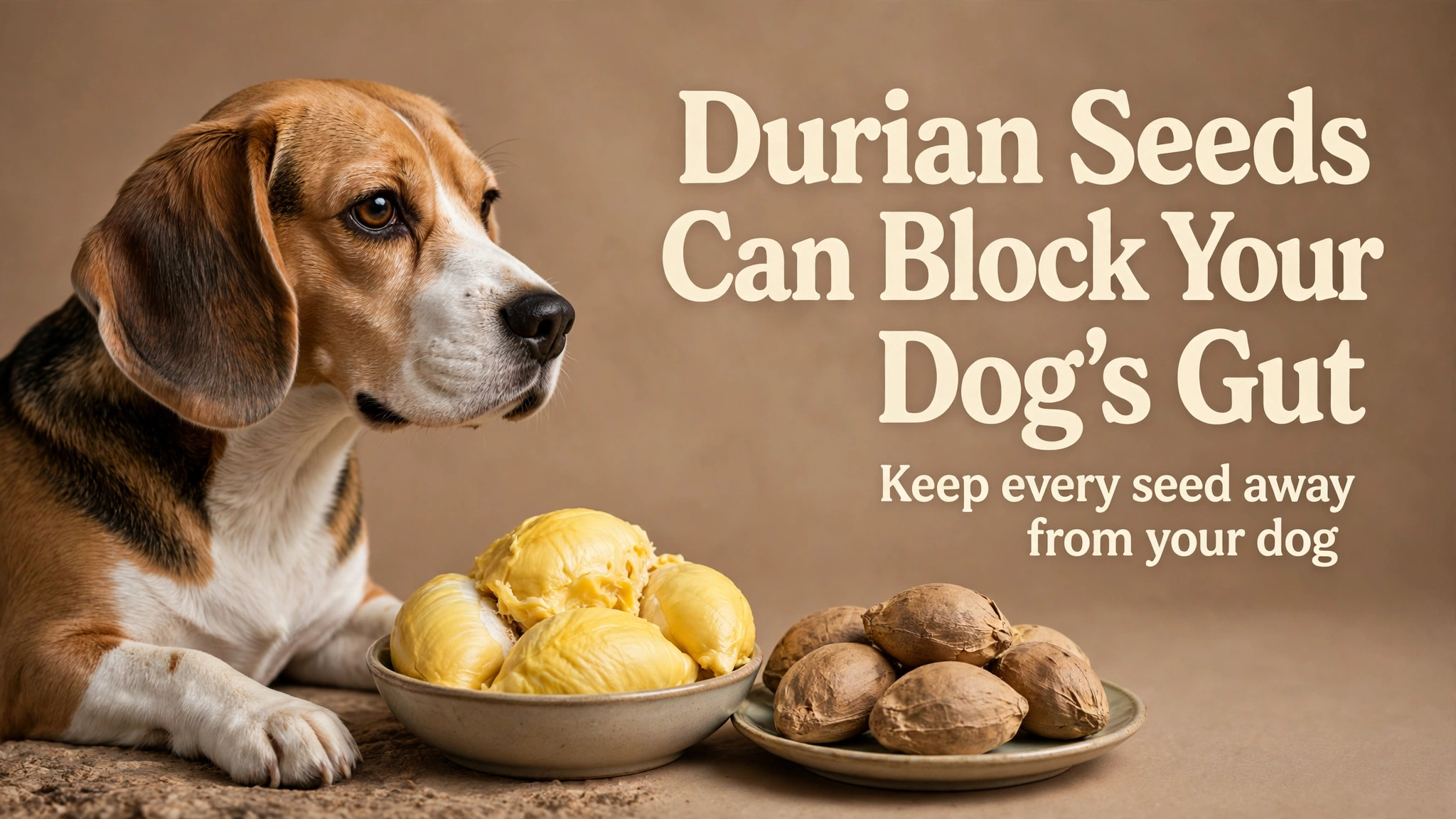
Durian Seeds Can Block Your Dog’s Gut
Durian Seeds Can Block Your Dog’s Gut
This is the most serious risk in this whole guide. A durian seed is about the size of a large grape or a small plum stone, smooth and hard. A small dog can choke on it at once. A medium or large dog can swallow it whole and seem fine for hours. Then the seed can get stuck in the stomach or in the narrow gut. This is called a blockage, and it is an emergency.
Raw durian seeds also carry compounds that are not safe to eat raw. Some guides mention cyclopropene fatty acids in raw seeds. Others mention small amounts of cyanide like compounds. Do not let a dog eat durian seeds, raw or cooked. The choking risk alone is enough to keep them away. Watch for vomiting again and again, a swollen or sore belly, no interest in food or water, weak energy, straining without passing stools, or drooling with signs of pain. These signs can start within a few hours or take a day to show. Do not try to make your dog vomit at home unless a vet tells you to do so. Call your vet at once, and tell them the size of your dog and when the seed was eaten.
How Much Durian Is Safe? Calorie Math by Dog Size
Durian is a rich fruit. A 100 gram serving of fresh flesh holds about 150 calories, about 27 grams of carbohydrate, about 5 grams of fat, and about 3.8 grams of fiber. Treats should stay under 10 percent of a dog’s daily calories. One tablespoon of durian flesh already holds about 22 calories. So a small dog reaches its treat limit with a single small bite.
Use this simple guide, and always stay below it. A small dog of 5 to 10 pounds can have no more than one teaspoon of flesh, about 5 grams, on a rare day. A medium dog of 20 to 40 pounds can have up to one tablespoon, about 15 grams, once in a while. A large dog of 50 pounds or more can have up to two tablespoons, about 30 grams, on a rare day. Keep durian days rare, no more than once a week at most, and count it as the only treat that day.
Fresh vs Frozen vs Dried Durian
Fresh vs Frozen vs Dried Durian
Fresh durian is the least risky form, and only when it is plain flesh with seeds removed. It has no added sugar, salt, or oil. The texture is soft, so a small piece is easy to chew and swallow. If you offer fresh durian, serve it at room temperature in a tiny piece, and watch your dog for a full day after.
Frozen durian is common in stores outside Asia. The flesh is often sold in pods or packs. It is still plain fruit if the label lists only durian, but you must thaw it and remove every seed before serving. Never serve a frozen chunk with a seed still inside. Read the pack first. If it lists added sugar, syrup, or milk, skip it. Dried durian and durian chips are the riskiest form. Drying takes out water and leaves sugar and calories packed into a small piece. Some packs add sugar, oil, or salt. Durian candy, durian ice cream, durian cake, durian mooncake, and durian puff are human desserts, not dog treats. The rule is simple. Fresh plain flesh only. Skip dried fruit, skip chips, and skip every durian dessert.
A Safe First Taste Protocol for Durian
Never give durian as a first new food on a busy day. Pick a calm day at home when you can watch your dog for a full day. Start by asking your vet if your dog has any health problem, a sensitive stomach, or a weight issue. If your vet says it is fine to try, follow these steps in order.
First, pick a ripe fresh durian and remove a small piece of flesh with clean hands. Pull the seed out and check both sides of the piece. Cut the flesh into a piece the size of a pea for a small dog, or the size of a small grape for a large dog. Second, offer it from your hand or in the food bowl, and let your dog sniff first. If your dog turns away, stop there. A refusal is a fine answer. Third, if your dog eats it, watch for the next 24 hours. Look for soft stools, gas, vomiting, a sore belly, or low energy. If your dog shows any upset, stop durian for good and tell your vet what happened. Do not try a second piece on the same day.
Dogs Who Should Skip Durian Completely
Some dogs should never taste durian, even in a tiny amount. The sugar and fat are too much for them, and the risk is not worth a single bite. Dogs with diabetes should skip it, because the natural sugar can raise blood sugar fast. Dogs with a history of pancreatitis should skip it too, because fat is a known trigger for a flare up. Overweight dogs should skip it, since the calories add up fast and weight loss is already hard work. Dogs with a sensitive stomach or food allergies should skip it too.
Puppies should skip it. Their guts are still growing, and they need steady puppy food, not rich fruit. Senior dogs with kidney, liver, or heart problems should skip it unless a vet says otherwise. Dogs that eat fast or gulp food should skip it, because they are more likely to swallow a seed whole. If your dog takes medicine that affects blood sugar, fat digestion, or the gut, ask your vet first. When in doubt, the safe choice is always to skip it.
What to Do If Your Dog Eats Durian Seeds or Too Much Flesh
Stay calm and act fast. First, take away any durian that is left, including husk, seeds, and flesh on the floor. Check your dog’s mouth for a seed or a piece of husk stuck between teeth. Do not put your hand deep into the mouth of a dog that is choking or in pain unless you can see the object clearly and remove it safely.
If your dog ate only a small piece of flesh, watch it for 24 hours. Mild soft stools or gas may pass on their own. Call your vet if vomiting lasts more than a day, if stools stay watery, if your dog will not eat or drink, or if your dog seems weak or in pain. If your dog ate a seed, a piece of husk, or a large amount of flesh, call your vet at once. Do not wait for signs. Tell the vet how much was eaten, when it happened, and the size and age of your dog. The vet may ask you to come in for an exam, an x ray, or fluids. A blockage can need surgery, and early care makes surgery less likely.
Safer Fruit Treats Than Durian for Dogs
Durian is a rare and risky treat. Most dogs are happier with fruit that is lower in sugar and fat, easier to serve, and free of large seeds. Blueberries are a fine choice. They are small, soft, low in sugar, and rich in antioxidants. A few berries are enough for most dogs. Apple slices without seeds or core are another good choice. They are crisp, full of fiber, and low in fat. Banana is sweet and soft, so keep it to one or two small slices. Watermelon without seeds or rind is a good summer treat because it is mostly water and easy to digest.
Strawberries, pears without seeds, and plain pumpkin are also fine in small amounts. Wash every fruit first, cut it into small pieces, and remove all seeds, pits, and rind. If you want to learn how another fruit can be risky in a different way, read our guide on cherries for dogs. The best treat is often the simplest one, a small piece of a safe fruit your dog already enjoys.
Conclusion: The Bottom Line on Durian for Dogs
Can dog eat durian and stay safe? A tiny taste of plain flesh is not toxic for most healthy adult dogs, but durian is still a poor choice as a regular treat. The sugar and fat are high, the calories add up fast, and the seeds and husk are truly dangerous. If you do share it, keep the rules in mind. Flesh only, seed free, husk free, fresh and plain, a tiny piece, and only on a rare day. Skip it for puppies, senior dogs, and dogs with diabetes, weight problems, or a sensitive stomach. Watch your dog for a full day after a first taste, and call your vet fast if a seed was swallowed or if signs of trouble appear.
Frequently Asked Questions About Durian and Dogs
Can dog eat durian flesh in a small amount?
Yes, a tiny taste of plain flesh with no seed and no husk is not toxic for most healthy adult dogs. Keep it to one teaspoon for a small dog or up to one tablespoon for a medium dog, and only on a rare day.
Can dogs eat durian seeds?
No, never let a dog eat durian seeds. Seeds can choke a dog or block the gut. If your dog swallows a seed, call your vet at once.
Is the smell of durian harmful to dogs?
No, the smell itself is not harmful. It comes from sulfur compounds that can smell strong to a dog’s sensitive nose. Some dogs may sneeze or walk away. Let your dog leave the room if it wants to.
How much durian can a dog eat in one day?
Stay below 10 percent of daily calories from treats. That means about one teaspoon of flesh for a small dog, up to one tablespoon for a medium dog, and up to two tablespoons for a large dog, on a rare day only.
What should I do if my dog eats too much durian?
Take away the rest of the fruit, offer fresh water, and watch your dog for 24 hours. Call your vet if vomiting or diarrhea lasts more than a day, or if your dog seems weak or in pain.
Can puppies eat durian?
No, puppies should not eat durian. Their guts are still growing and they need steady puppy food. A rich and fatty fruit can upset a puppy fast. Wait until your dog is an adult and ask your vet first.
Is dried durian safe for dogs?
No, dried durian is not a good choice. Drying packs sugar and calories into a small piece, and many packs add sugar, oil, or salt. Durian candy, ice cream, cake, and puff are human desserts and should never be given to a dog.
What fruit treats are safer than durian for dogs?
Blueberries, apple slices without seeds, seedless watermelon, strawberries, and pears without seeds are safer and lower in sugar and fat. Serve them washed, cut small, and in tiny amounts.
Bella Barker is a pet food safety writer with 10+ years of experience. She researches what dogs and cats can (and can't) eat and turns it into simple, practical guides for everyday pet parents. 🐶🐱
If you picked blackcurrants at a market stall and your dog stared at the dark berries in your basket, you have probably asked the exact question in this title: can dogs eat blackcurrants? Here is the short answer: a few fresh blackcurrants are generally low risk for most healthy dogs, but they are a rare…
If your dog is staring at the packet of corn thins in your hand, you want a straight answer before you share a piece. The short version is this: can dogs eat corn thins? Yes, a plain corn thin is safe for most dogs in a small amount, but the flavoured kinds can hide ingredients…
It is a hot afternoon, you have a tall glass of horchata sweating on the table, and your dog is doing the stare. The drink looks gentle enough. It is milky, sweet, and dusted with cinnamon, with no chocolate or grapes in sight. So is horchata bad for dogs, or is one shared sip harmless?…
Your dog is sitting next to you while you eat a pear, eyes locked on every bite, and you are wondering whether sharing a slice is safe. The short answer is good news. Fresh pear flesh is safe for dogs, and it is a sweet, juicy treat most dogs enjoy. The part you need to…
You know the scene. You sit down with Vegemite on toast, and your dog is already there, staring at you with total focus. The smell is strong, savoury, and hard to ignore, and your dog clearly wants a taste. So can dogs have Vegemite, or should the jar stay strictly for humans? Here is the…
Yes, dogs can eat carrots. Served raw or cooked, plain and cut to a safe size, they make a healthy low calorie treat for most dogs. They are packed with beta carotene, fiber, and vitamins that support the eyes, digestion, and the immune system. Like every treat, they belong inside the 10 percent rule: all…