If your vet has just handed you a small white tablet and a set of instructions, you probably have one question on your mind: how much tramadol should my dog get? The question of tramadol dog dosage has a short answer. Vets usually work from a range of 2 to 5 mg per kg of body weight, given by mouth every 8 hours, and your vet picks the exact number inside that range for your dog. That short answer needs care around it, because the range in the books is wide, the tablets only come in fixed sizes, and some dogs should never get this drug at all. This guide explains how vets work out the amount, how the tablet math works, how to tell if it is helping, and the traps that catch owners. Every amount here is a published range meant to inform your talk with your vet, and your vet picks the amount for your dog.
A Note on Health Advice
Tramadol is not approved by the Food and Drug Administration for use in dogs. A vet who prescribes it is using it off label, leaning on vet formularies, published studies, and clinical experience instead of a dog specific label. It is also a Schedule IV controlled substance in the United States, which means it is a prescription only drug with rules about how it is stored and dispensed. Do not start it, change the amount, or stop a course your vet planned unless your vet tells you to. The numbers in this guide are the ranges vets usually work from, and they are not a plan for dosing your dog at home. Read this article as background for your talk with your vet, not as a replacement for that talk. If your dog shows any warning sign listed here, stop the medicine and call your vet at once, or an emergency vet clinic if your own vet is out of reach.
What Tramadol Is and Why Vets Reach for It
Tramadol is a synthetic opioid painkiller, which means it is made in a lab and works on the same pain pathways in the brain as morphine, but more weakly. It works in two ways at once. First, it binds weakly to mu opioid receptors in the brain and spinal cord, which changes how pain signals travel and how the brain reads them. Second, it blocks the reuptake of two brain chemicals, serotonin and norepinephrine, which raises their levels and adds to the pain relief. That second action is the reason tramadol interacts with so many other medicines, and it is the reason this guide has a whole section on the serotonin check. You can read more about the drug itself on the Wikipedia page for tramadol, which covers its history and its chemistry in plain terms.
Vets reach for tramadol when a dog has moderate to severe pain. The most common reasons are pain after surgery, osteoarthritis in older dogs, cancer pain, pain from a slipped disc, lameness, and pain from an injury. Vets also use it at times for coughing and for anxiety, because the serotonin effect can calm a dog, though it is rarely the first choice for either. One limit matters from the start. Tramadol is not an anti-inflammatory, so it does nothing to the swelling or the cause of the pain. It only changes how the dog feels the pain. That is why vets often pair it with an anti-inflammatory drug such as meloxicam, and for a look at how vets set up and keep watch over another long term dog medicine, see our guide to meloxicam dosage for dogs, which covers the dosing, the checks, and how the plan changes over time. Dogs also make less of tramadol’s active metabolite, called M1, than people and cats do, which is one reason the same dose can work well in one dog and barely help another.
The Short Answer: What Vets Usually Prescribe
For most dogs, the vet range is 2 to 5 mg per kg of body weight, given by mouth every 8 hours. In pounds, that works out to about 1 to 2.3 mg per pound per dose. The licensed vet product in the United Kingdom lists a slightly narrower range of 2 to 4 mg per kg every 8 hours, with a minimum gap of 6 hours between doses and a daily ceiling of 16 mg per kg. Other vet sources quote wider ranges, and some guides list up to 10 mg per kg for severe pain under close vet care, which shows how much the numbers can differ from one source to the next. Your vet weighs your dog, checks the liver and kidneys, looks at the other medicines, and picks a starting point, usually at the low end. The dose for short term pain after surgery may differ from the dose for long term arthritis pain, and the dose for a small puppy differs from the dose for a large senior. Never try to work out the amount yourself from a chart, because the chart gives a range and your vet gives a dose.
The Dose Range Vets Work From
The numbers below are the published ranges, not a prescription. The Merck Veterinary Manual and Plumb’s Veterinary Drug Handbook list tramadol for dogs at 2 to 5 mg per kg by mouth every 8 hours. The United Kingdom vet label for the licensed tramadol tablet lists 2 to 4 mg per kg every 8 hours, with a minimum gap of 6 hours and a maximum of 16 mg per kg in a day. For cancer pain, some vets give it as often as every 6 hours, but only under their direct care. Vets almost always start at the low end of the range, especially in small dogs, older dogs, dogs with liver or kidney trouble, and dogs taking the drug for the first time. If the low dose does not help, the vet may raise it in steps, or may add a second pain drug instead of pushing the tramadol higher. Do not increase the amount on your own when the first dose seems to fall short, because a larger dose will not make a drug that is failing start to work, and it only adds risk. If the amount your vet chose is not easing the pain, book a vet visit instead of reaching for another tablet.
The Weight Table: What the Range Means for Real Dogs
A range in mg per kg is hard to picture, so the table below turns it into real numbers for real dogs. It uses the 2 to 5 mg per kg range and the standard 50 mg tablet. Remember that your vet rounds the result to a practical tablet amount, so the prescribed dose will not match the table exactly, and that is normal.
Dog weight
Low end at 2 mg per kg
High end at 5 mg per kg
Tablet amount this points to
10 pounds (4.5 kg)
9 mg
23 mg
Quarter to half a 50 mg tablet
25 pounds (11.3 kg)
23 mg
57 mg
Half to one 50 mg tablet
50 pounds (22.7 kg)
45 mg
114 mg
One to two 50 mg tablets
75 pounds (34 kg)
68 mg
170 mg
One and a half to three and a half tablets
100 pounds (45.4 kg)
91 mg
227 mg
Two to four and a half tablets, vet to confirm
At three doses a day, a 50 pound dog would take 135 to 342 mg in total per day by the book, and the licensed daily ceiling of 16 mg per kg would allow up to 363 mg for that dog. See how far apart the low end and the high end sit. A 50 pound dog could sit anywhere from 45 mg to 114 mg per dose, and that spread is exactly why the vet, not a chart, should set the amount. Giant dogs need extra care, because dogs do not clear tramadol in direct proportion to body weight, so a vet usually starts a very large dog at the low end rather than scaling the dose straight up. Dogs under 7 pounds need special care too, because even a quarter of a 50 mg tablet may be too much for them, and your vet may use a compounded liquid so the amount can be measured in small steps.
The 50 mg Tablet Problem: Why the Chart Never Matches the Prescription
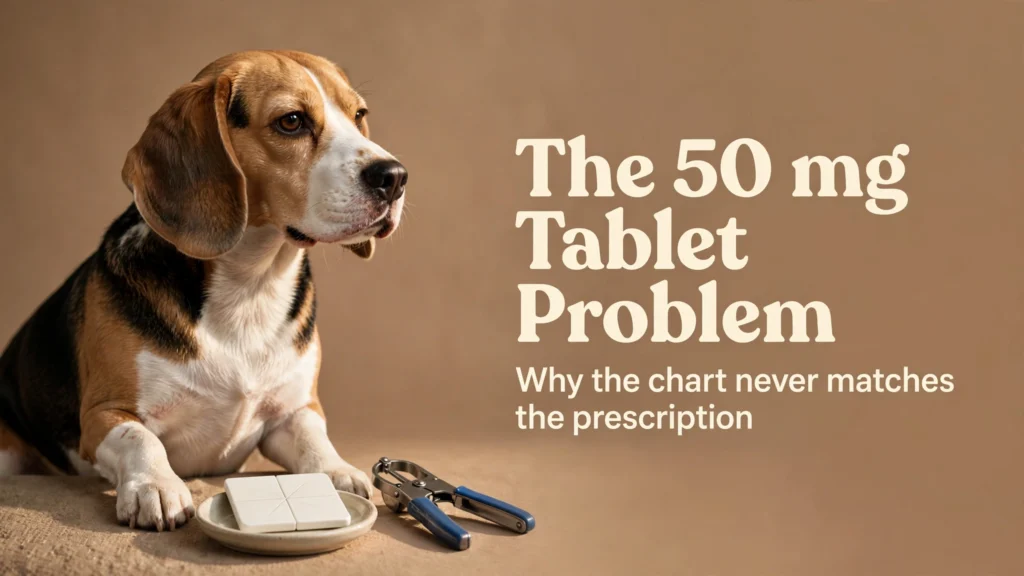
Most tramadol for dogs comes as a 50 mg tablet, and that single size is the reason the chart and the prescription never line up. The tablet is scored, so it can be split into halves of 25 mg and quarters of 12.5 mg, but it cannot be split into 9 mg or 23 mg or 57 mg, which are the numbers the weight math gives. Your vet rounds the math to the nearest quarter tablet, and that rounding is part of the plan, not a mistake. A 10 pound dog whose math says 9 to 23 mg will usually get a quarter tablet, which is 12.5 mg, or a half tablet, which is 25 mg. A 25 pound dog whose math says 23 to 57 mg will usually get a half tablet or a whole tablet. The rounding also explains why the dose your vet picked may look higher or lower than a chart you found online. The chart gives a range, the tablet gives a few fixed sizes, and the vet picks the fixed size that fits your dog best. Split tablets with a pill cutter for a clean break, since a crumbled piece is hard to measure, and keep the cut pieces in the original pack so the strength stays plain to see. If your dog is very small, ask your vet about a compounded liquid, which a pharmacy can make at a strength that fits your dog, and check the liquid label for xylitol, which is toxic to dogs and turns up in some flavored syrups.
How to Give It: Food, Timing, and the Bitter Taste
Give tramadol by mouth, and give it with a small amount of food. The tablet tastes bitter, and many dogs gag or drool after taking it plain, so food helps twice over: it masks the taste and it settles the stomach. A spoonful of wet food, a small piece of plain chicken, or a pill pocket all work, as long as you watch your dog swallow the whole tablet so you know the full amount went in. If your dog spits the tablet out or vomits it back up within a few minutes, do not give another one. Call your vet first. Keep at least 6 hours between doses, even if the last dose seemed to wear off early, and never give two doses close together to make up for a weak one. If your vet set an every 8 hour schedule, that means three doses a day, spaced through the day and night as evenly as you can manage. Set a phone alarm for each dose, because a steady schedule keeps the pain relief level, and a missed dose lets the pain come back before the next one. Store the tablets in a locked place, away from children and other pets, because tramadol is a controlled substance and a dog that gets into the pack can eat far too many tablets at once.
How Long Before It Works, and How to Tell If It Is Working
Tramadol starts working fast. Most dogs feel it within 1 to 2 hours of a dose, and the effect peaks at about 2 to 4 hours. For short term pain after surgery, that quick start is the whole point. For long term pain such as arthritis, the full effect can take 1 to 2 weeks of steady dosing, so do not judge it after a single tablet. The effect of one dose lasts up to 12 hours in some dogs, but most vets still give it every 8 hours, because the pain relief fades before the 12 hour mark in many dogs. The hardest part for an owner is judging whether it is helping, because dogs hide pain well and a dog that sleeps more may be resting comfortably or may simply be sedated. A simple pain diary solves this. Once a day, write down four things on a scale of 1 to 10: how easily your dog gets up, how willingly your dog walks and climbs stairs, how much your dog eats, and how soundly your dog sleeps. Note the time of each dose next to the scores. After a week, the pattern will show whether the good hours line up with the doses. Bring the diary to the recheck, because it gives your vet real data to work with instead of a guess, and it shows clearly if the dose needs to change or if a second pain drug should join the plan.
The Arthritis Question: Why Tramadol Alone Often Disappoints
Many owners are surprised to learn that tramadol is a weak tool for arthritis on its own. In a 2018 study published in the Journal of the American Veterinary Medical Association, 40 dogs with elbow or knee arthritis were given tramadol, carprofen, or a placebo, and tramadol was no better than the placebo at easing pain or improving movement, while carprofen did help. That does not mean tramadol is useless. It means it works best as a supporting player, not as the star. Vets now use it as part of a multimodal plan, which means several smaller tools working together: an anti-inflammatory such as carprofen or meloxicam for the swelling, tramadol for the pain signal, and at times gabapentin or amantadine for nerve pain. Weight control, controlled exercise, and physical therapy sit alongside the drugs. If your arthritic dog is on tramadol alone and still limps, still hesitates at stairs, or still sleeps the day away, tell your vet. The answer is usually not more tramadol. It is a second drug, a different drug, or a change in the plan, and your vet can pick the next step from real evidence instead of guesswork.
The Human Medicine Cabinet Trap: Never Share Your Own Tramadol
The most dangerous tramadol mistake is also the most common one: giving your dog a tablet from a human prescription. Human tramadol comes in the same 50 mg tablet, so it looks safe, but the dose for a person is not the dose for a dog, and some human products contain a second drug that can kill a dog. The product called Ultracet mixes tramadol with acetaminophen, which is the painkiller in Tylenol, and acetaminophen is toxic to dogs. It can damage the liver and the red blood cells, and even a single tablet can be dangerous for a small dog. Extended release human tablets are another trap. They are made to release the drug slowly over 12 or 24 hours in a person, but dogs clear tramadol too fast for that design, so an extended release tablet does not give a dog steady relief, and it can still cause side effects. Never give your dog any tramadol product that was prescribed for a person, and never give your dog a tramadol product made for another pet without checking with your vet first. The safe rule is simple: the only tramadol your dog gets is the one your vet dispensed for your dog, in the amount your vet wrote down.
The Serotonin Check: Medicines That Must Never Mix With Tramadol
Tramadol raises serotonin in the brain, and that is what makes it risky to mix with other drugs that also raise serotonin. Too much serotonin can cause serotonin syndrome, which is a medical emergency. The signs are agitation and hyperactivity that can grow into tremors, seizures, a high temperature, and dilated pupils. If you see your dog become oddly wired, shaky, or hot after a dose, stop the medicine and call your vet at once. Before the first dose, check your dog’s whole medicine list against the list below, and tell your vet about every drug and supplement your dog takes, including anything bought without a prescription.
Selective serotonin reuptake inhibitors, such as fluoxetine, sertraline, paroxetine, and fluvoxamine, which vets use for anxiety and behavior problems
Monoamine oxidase inhibitors, such as selegiline, which vets use for canine cognitive dysfunction and Cushing’s disease
Trazodone, which vets use for anxiety and for calming a dog before a vet visit
Amitriptyline and other tricyclic antidepressants
Other opioids, such as fentanyl and buprenorphine, and the anti nausea drug metoclopramide
Tramadol can also add to the effect of sedatives, anxiety drugs, seizure drugs, and muscle relaxants, so a dog on any of those needs a vet to weigh the mix. The anti nausea drug ondansetron and the heart drug digoxin can also interact with it. The check takes five minutes and it is the single most useful safety step in this whole guide, because most tramadol emergencies come from a mix that nobody checked, not from the tramadol alone.
Side Effects: What Is Normal and What Needs a Call
Most dogs handle tramadol well, and side effects are usually mild. The one owners see most often is sleepiness, and for a dog in pain many owners count that as a help, not a problem. Other mild signs are nausea, vomiting, a smaller appetite, constipation, diarrhea, anxiety, dizziness, tremors, panting, and dilated pupils. Mild signs like these tend to wear off within 8 to 12 hours as the drug clears, and they tend to go away once the medicine is stopped. Still, report them to your vet, especially if they last more than a day, because a mild sign that lingers can mean the dose is too high for that dog. Some dogs show the opposite of sleepiness and become restless or oddly excited, and a few dogs drool after a dose because of the bitter taste. Call your vet at once if you see heavy sedation, trouble breathing, a slow heart rate, wobbling, confusion, or a collapse. Those signs mean the drug is hitting too hard, and your dog needs a vet now, not tomorrow.
Dogs That Should Not Get Tramadol
Tramadol is not safe for every dog, even at the right amount, and some dogs should never receive it at all. Do not give it to a dog with a known allergy to tramadol or to other opioids. Vets also avoid it, or use it only with great care, in dogs with epilepsy or a history of seizures, because tramadol can lower the seizure threshold and make a seizure more likely. Dogs with liver or kidney disease need a lower amount or a longer gap between doses, because those organs clear the drug from the body, and when they work slowly the drug stays active for longer. Skip it for pregnant or nursing dogs unless your vet gives a clear go ahead, since the drug can pass to the puppies through the placenta and the milk. Very young puppies should not receive it, and older dogs deserve a closer eye, because aging kidneys and liver clear the drug more slowly and older dogs often take other medicines that can interact with it. A last word for working dogs: drowsiness can dull a dog that needs to stay alert, so tell your vet if your dog works as a service dog, a search dog, or a herding dog. Tell your vet about every medicine and supplement your dog already takes, because the serotonin check in the section above is the step that keeps this drug safe.
Missed a Dose, Gave Too Much, or Want to Stop: Three Protocols
Forgetting a dose happens to every owner sooner or later. If a dose slips your mind, give it when you remember it, as long as the next dose is not due soon. If the next dose is close, skip the missed one and carry on as normal. Never give two doses at once to make up for the one you missed, and keep at least 6 hours between any two doses. If you think your dog got too much, act right away, even if your dog still looks fine. An overdose of tramadol can cause heavy sedation, slow or shallow breathing, a slow heart rate, wobbling, drooling, vomiting, tremors, seizures, loss of consciousness, or a coma, so do not wait for signs to appear. Stop giving the drug and ring your vet straight away. If your own vet cannot be reached, ring an emergency vet clinic, the ASPCA Animal Poison Control line at 888-426-4435, or the Pet Poison Helpline at 855-764-7661. The call may carry a fee. Have the packet in your hand when you call, so you can read out the exact product, its strength, and how many tablets are missing. Do not try to make your dog vomit on your own, because forcing it can do more harm than good. Stopping needs care too. If your dog has taken tramadol for weeks, do not stop it suddenly on your own, because a sudden stop can bring withdrawal signs such as restlessness, anxiety, shaking, and diarrhea. Ask your vet for a taper plan, which usually means lowering the amount step by step over several days, and only then stopping.
Conclusion: The Bottom Line on Tramadol for Dogs
Tramadol can help a dog in pain, but it is not a simple drug, and it is not a drug to guess with. The vet range of 2 to 5 mg per kg every 8 hours is a starting point for a conversation with your vet, not a dose you work out at home. The 50 mg tablet will never match the chart exactly, the drug works best alongside other pain relief rather than alone, and the serotonin check is the safety step that matters most. The rules are simple and worth repeating: only use the tramadol your vet dispensed for your dog, give it with food, keep at least 6 hours between doses, never share a human tablet, and call your vet before the first dose and again if anything looks wrong. If the dose does not help, if the pain diary shows no change after a week or two, or if any warning sign appears, your vet is the next step, not a bigger dose. A calm plan, a vet you trust, and a dog that can move and rest in comfort are worth more than any tablet from the cabinet.
Frequently Asked Questions About Tramadol for Dogs
How much tramadol can I give my dog?
Your vet decides the amount. The published vet range is 2 to 5 mg per kg of body weight, or about 1 to 2.3 mg per pound, by mouth every 8 hours. A 25 pound dog often starts with half to one 50 mg tablet, and dogs under 7 pounds need a vet’s calculation, often with a compounded liquid.
How long does tramadol take to work in dogs?
Most dogs feel it within 1 to 2 hours of a dose, with the peak effect at about 2 to 4 hours. For long term pain such as arthritis, the full effect can take 1 to 2 weeks of steady dosing.
Can I give my dog tramadol from my own prescription?
No. Human tramadol products can contain acetaminophen, as in Ultracet, which is toxic to dogs, and extended release human tablets do not work the same way in dogs. Only use the tramadol your vet dispensed for your dog.
Is tramadol safe for dogs with arthritis?
It can help as part of a plan, but on its own it often disappoints. A 2018 study of 40 dogs with elbow or knee arthritis found tramadol no better than a placebo, while carprofen did help. Vets usually pair it with an anti-inflammatory and other tools.
What happens if my dog misses a dose of tramadol?
Give it when you remember it, unless the next dose is due soon. Then skip the missed one and carry on as normal. Never give two doses at once, and keep at least 6 hours between doses.
Can tramadol be given with gabapentin?
Yes, vets often combine them as part of a multimodal pain plan, and the mix is usually well tolerated. Your vet decides the amounts and watches for extra sedation, so do not start the mix on your own.
How long can a dog stay on tramadol?
It depends on the reason. After surgery it is often a few days. For chronic pain such as arthritis it can be months, with regular vet rechecks to watch the liver, kidneys, and whether it is still helping. Do not stop a long course suddenly; ask your vet for a taper plan.
What are the signs of too much tramadol?
Heavy sedation, slow or shallow breathing, a slow heart rate, wobbling, drooling, vomiting, tremors, seizures, loss of consciousness, or a coma. Stop the drug and call your vet at once, or the ASPCA Animal Poison Control line at 888-426-4435, or the Pet Poison Helpline at 855-764-7661.
Bella Barker is a pet food safety writer with 10+ years of experience. She researches what dogs and cats can (and can't) eat and turns it into simple, practical guides for everyday pet parents. 🐶🐱
You walk into the room and your dog is licking bright blue crumbs off the floor while your child holds an empty yellow tub. Your stomach drops, and the first question in your head is simple: your dog ate play doh, so is your dog in real danger? A small bite of store bought Play-Doh…
If your cat has started drinking more water than usual, you are asking the right questions. Chronic kidney disease is the most common long-term condition in senior cats, and learning about cat kidney disease early signs and stages now gives you the best chance of catching problems while they are still manageable. The Short Answer…
It is confusing to watch your cat finish meals and still get thinner. Food is going in, so weight should stay steady. When it does not, the problem is usually not the amount of food in the bowl. It is what the body does with that food after it is eaten. A cat losing weight…
Baking soda sits in almost every kitchen. You may use it to bake, to clean a sink, or to freshen a carpet. If you share your home with a cat, one question matters more than the rest: is baking soda safe for cats when they walk through it, lick it off a paw, or get…
If you are asking, are carnations safe for cats, here is the straight answer: no, carnations are mildly toxic to cats. The ASPCA lists the carnation as toxic to cats, dogs, and horses, with mild stomach upset and mild skin irritation as the listed signs. That sounds frightening, but here is the calmer truth behind…
After PineSol, the next “natural” cleaner most cat owners reach for is the big bottle of white vinegar under the sink. It is cheap, it has no perfume, and it feels safer than bleach or sprays. So is white vinegar safe for cats, or is that feeling wrong? The honest answer sits in the middle….