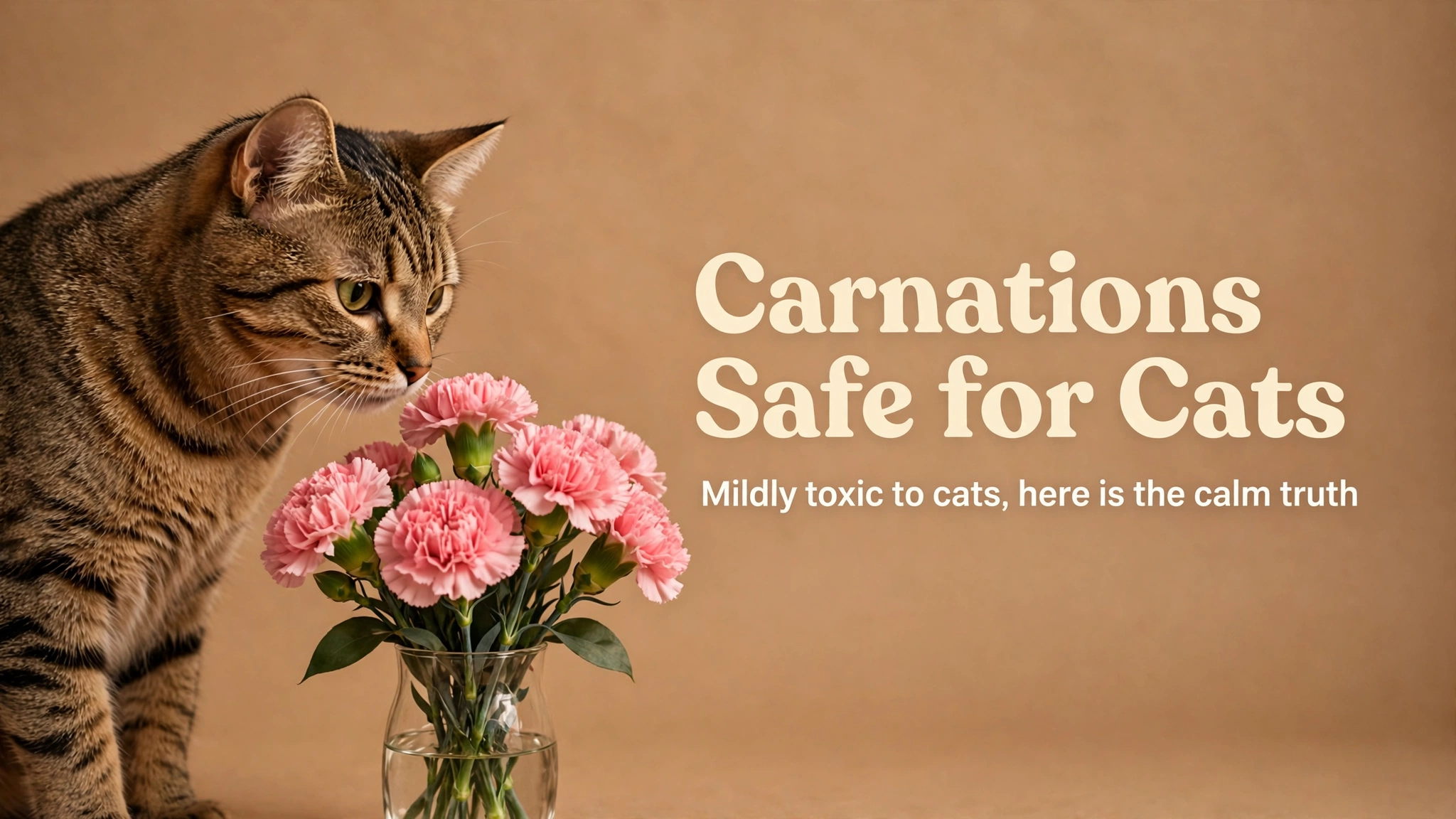
If you are asking, are carnations safe for cats, here is the straight answer: no, carnations are mildly toxic to cats. The ASPCA lists the carnation as toxic to cats, dogs, and horses, with mild stomach upset and mild skin irritation as the listed signs. That sounds frightening, but here is the calmer truth behind it. Carnations are not in the same league as lilies, which can cause fatal kidney failure in cats. Most cats that chew a carnation petal get a sore mouth, some drooling, and perhaps a short bout of vomiting, and then they recover within a day. This guide walks you through what is actually inside the plant, how cats usually get into it, what the first hours look like after a nibble, and exactly what to do, so you can stay calm and keep your cat safe.
The Honest Answer: Carnations Are Not Safe for Cats
The carnation, known to botanists as Dianthus caryophyllus, sits in the mild middle of the toxic plant list. It will not poison your cat the way a lily can, but it is not a plant you want your cat chewing on either. The ASPCA’s listing is clear: every part of the plant, from the ruffled petals to the stem, the leaves, and even the pollen, can cause trouble if your cat eats it or rubs against it.
To put the risk in perspective, there are no reported deaths from carnation poisoning in cats. The reaction is irritant based, not organ damaging. Your cat’s body treats the plant material as an irritant and works to get rid of it through drooling, vomiting, or diarrhea. That is uncomfortable for your cat and messy for you, but it is usually short lived. Still, mild does not mean harmless. A kitten, a senior cat, or a cat that eats a large amount can have a rougher time, so the safest house rule is simple: keep carnations out of your cat’s reach.
What Is Actually in a Carnation That Bothers Cats
The irritation comes from compounds in the plant’s sap called triterpenoid saponins, which are found across the Dianthus family. Interestingly, the exact toxic principle has never been pinned down with certainty. Veterinary sources describe it as an unknown irritant, possibly the saponins, because the pattern of symptoms matches what these soapy plant compounds do to soft tissue.
When your cat bites into a carnation, the sap irritates the mouth, the tongue, the esophagus, and the stomach lining. That is why drooling and mouth pawing often show up first. The same sap can cause contact dermatitis, which is skin inflammation, if it sits on your cat’s skin or around the lips. Pollen that lands on the coat can be licked off during grooming and cause the same mouth and stomach irritation. So the plant has three ways of causing trouble: eaten, rubbed, or groomed off the fur.
You can read more about the plant itself on Wikipedia’s page for Dianthus caryophyllus.
How Cats Usually Meet Carnations: The Bouquet Problem
Most indoor cats never meet a carnation in a garden. They meet it in a vase. Carnations are one of the most common cut flowers in the world, which means they show up in bouquets for Mother’s Day, Valentine’s Day, birthdays, graduations, and get well arrangements. A vase goes on the coffee table or the kitchen counter, petals fall on the floor, and a curious cat investigates.
This is where the real risk lives, and it is not the flower alone. Mixed bouquets often contain a dozen different stems, and most people cannot name every flower in the bunch. A bouquet with carnations might also hold lilies, and lilies are a genuine emergency for cats. So the bouquet problem has two layers: the mild irritation from the carnations, and the chance that something far more dangerous is sitting in the same vase. Outdoor cats can also find carnations planted in flower beds, but a vase on a low table is by far the more common meeting point.
How to Spot a Carnation in a Mixed Bouquet
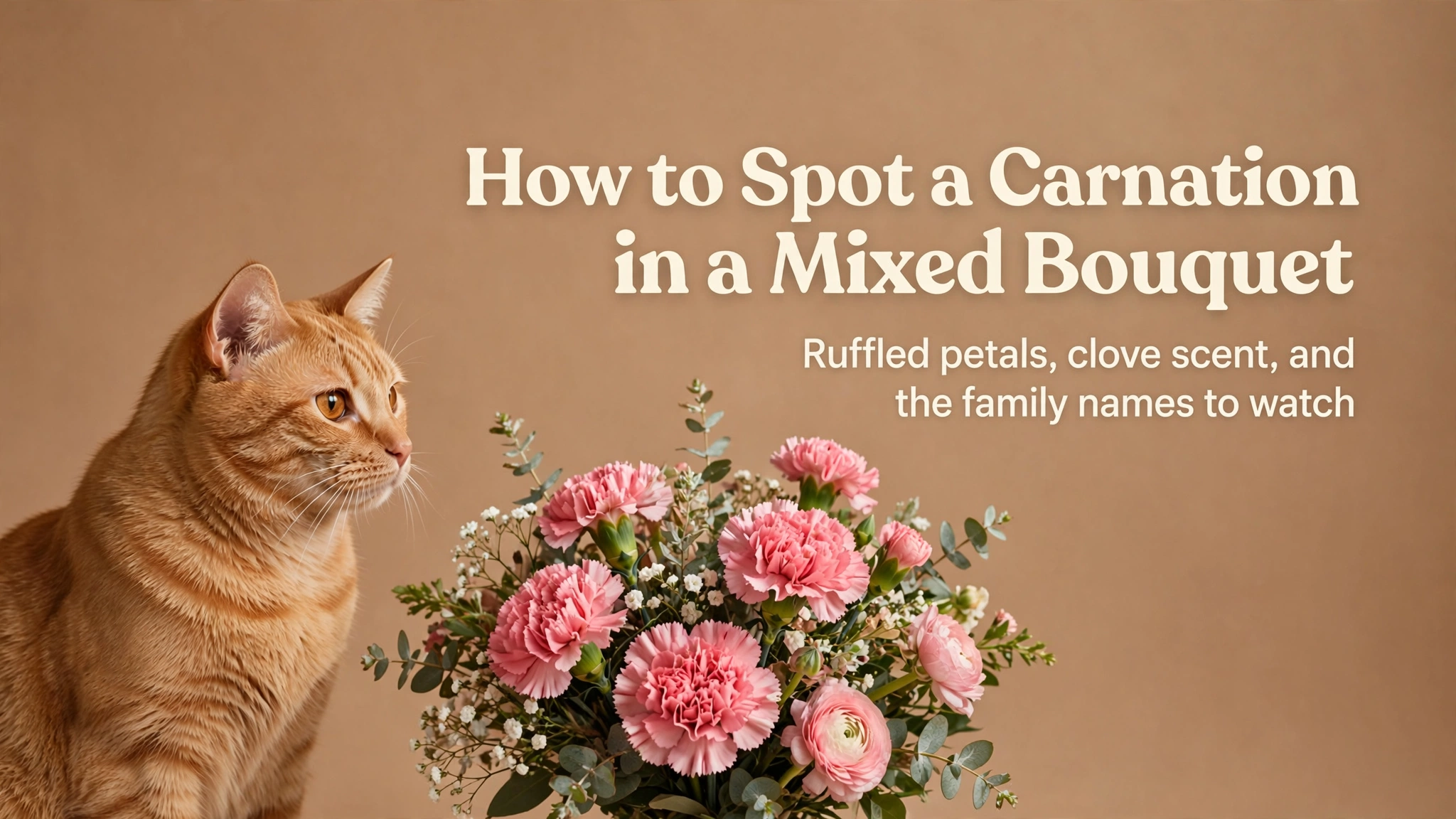
If you want to pull the risky stems out of a bouquet, you first need to recognize them. Carnations are easy to identify once you know the signs. The petals have ruffled, fringed edges that look almost torn, quite unlike the smooth petals of a rose. They carry a sweet, spicy scent that many people describe as clove like. The blooms come in pink, red, white, yellow, and striped combinations, and the stems have a slightly swollen jointed look with narrow gray green leaves.
Watch out for the family names too. Pinks, sweet William, and border pinks are all Dianthus, the same plant family with the same caution attached. So are spray carnations, the miniature type with five or six small blooms on one stem, which are popular in boutonnieres and small arrangements. If a bouquet arrives with a florist card, check the flower list on it. If you cannot identify a stem and your cat is a known plant chewer, take that stem out. Removing one flower is a small price for peace of mind.
Symptoms Timeline: The First Six Hours After a Nibble
Knowing what to expect hour by hour makes the whole thing far less scary. Here is the usual pattern after a cat chews on a carnation.
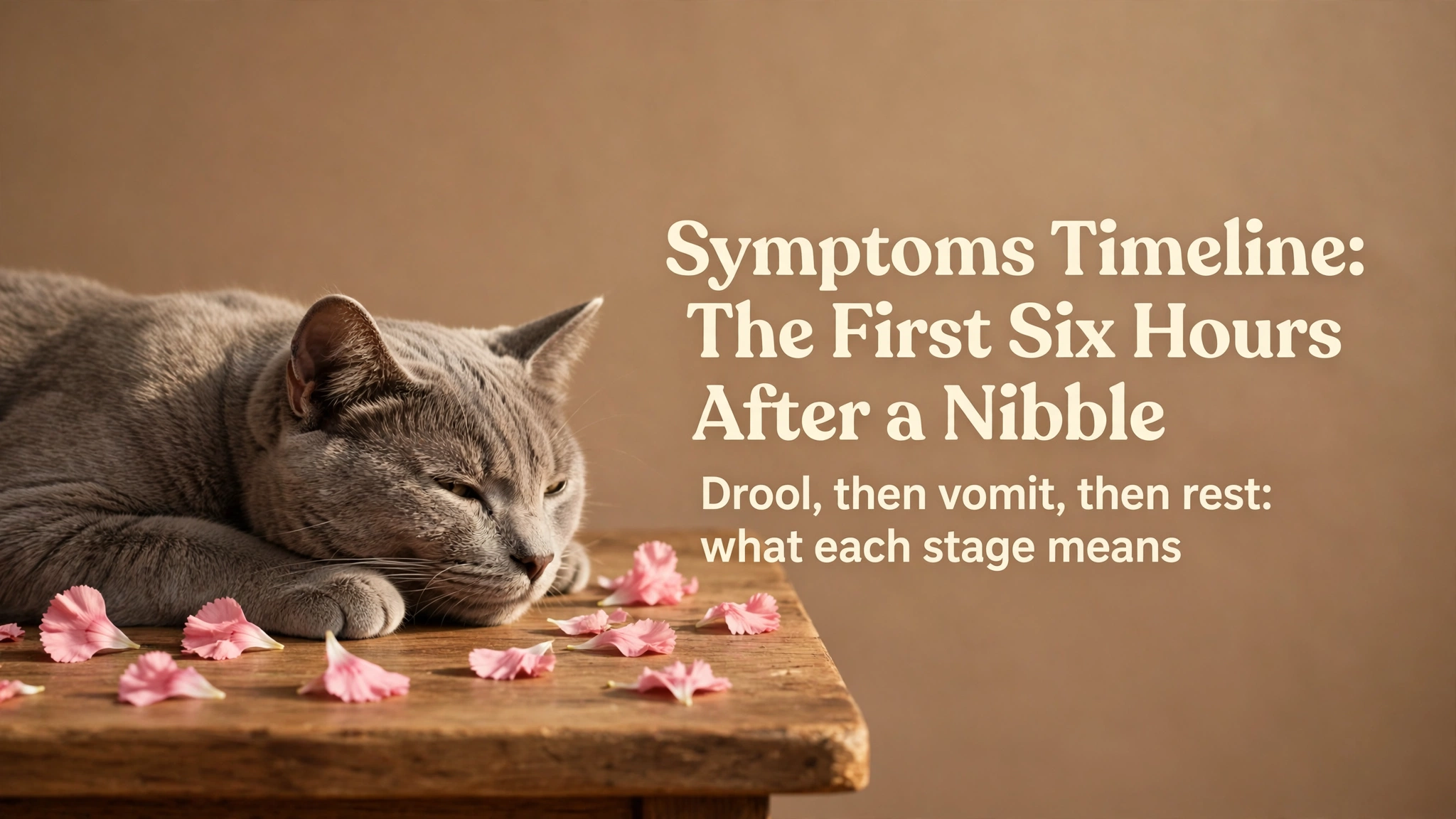
In the first thirty minutes, you will likely see drooling, lip licking, or pawing at the mouth. This is the sap irritating the mouth and tongue. Your cat may shake its head or rub its face on the floor. This stage looks dramatic but it is just local irritation.
Between thirty minutes and two hours, vomiting may start, and some cats develop diarrhea. This is the stomach and intestines reacting to the irritant. The vomiting is actually the body doing its job, pushing the plant material out. Most cats vomit once or twice and then settle.
From two to six hours, things usually calm down. Your cat may be quieter than usual and may skip a meal, which is normal after an upset stomach. The thing to watch now is water. Vomiting and diarrhea cause fluid loss, and a dehydrated cat becomes lethargic with dry gums. If vomiting or diarrhea continues for hours, dehydration becomes the real worry, and dehydration puts extra strain on the kidneys. That is why senior cats need closer watching, and you can learn the warning signs in our guide on cat kidney disease early signs and stages. By the next day, most cats are back to normal.
Smell, Touch, or Taste: Which Exposures Actually Matter
Not every kind of contact with a carnation is equal, and knowing the difference saves you from unnecessary panic.
Smelling a carnation is not dangerous. The toxicity is not carried in the scent, so a cat that sniffs a bouquet and walks away has nothing to worry about. The problem starts with touch. If your cat rubs its face on the blooms, pollen or sap on the skin can cause mild dermatitis, redness, or itching, especially around the lips and nose. Cats that get pollen on their coat will groom it off, which turns skin contact into a small swallowed dose.
Eating is the exposure that causes the stomach symptoms described above. Even then, a single chewed petal is a very different event from a cat that shreds half a bouquet. The practical takeaway is straightforward: sniffing is fine, touching can irritate the skin, and eating irritates the stomach. All three are avoided with the same simple rule, which is to keep the plant and any fallen petals out of your cat’s reach.
What About the Vase Water?
Here is a question almost nobody asks, and it matters. Cats love drinking from vases. The water in a carnation vase is not just water. It often contains a flower food packet from the florist, and it can carry pesticide residue from the farm, fertilizer traces, and bacteria that grow as stems decay in the water. Even if the flowers themselves were safe, that water is not something you want your cat drinking.
Change the vase water every two days, skip the flower food packet if your cat drinks from vases, and rinse the stems before arranging. Better still, put the vase somewhere your cat cannot reach in the first place, like a closed room or a high shelf with no landing space nearby. A cat that cannot reach the vase cannot chew the flowers or drink the water.
When to Watch at Home and When to Call the Vet
Most carnation nibbles can be handled at home. If your cat chewed a petal or two, drooled a little, vomited once, and is now acting normally, you can monitor. Remove the carnations from the room, pick up every fallen petal and leaf from the floor, and offer fresh water. Do not try to induce vomiting and do not give home remedies. Just watch.
Call your veterinarian or the ASPCA Animal Poison Control Center at (888) 426-4435 if any of the following apply. Vomiting or diarrhea that keeps repeating. Your cat refuses food for a full 24 hours. Lethargy, weakness, or signs of dehydration like dry gums. Your cat is a kitten, a senior, or has a known health condition. You do not know how much was eaten. Or the bouquet contained other flowers you cannot identify, because a mixed bouquet may hold something far more dangerous than carnations. If you do call, bring a photo or a sample of the flower so the vet can confirm what your cat ate.
Kittens, Seniors, and Sensitive Cats Need Extra Care
The mild label on carnations assumes a healthy adult cat that ate a small amount. Three groups deserve extra caution. Kittens are the most likely to chew plants out of pure curiosity, and their small bodies feel a bigger effect from the same nibble. Senior cats, especially those with early kidney trouble, handle dehydration poorly, so even a short bout of vomiting deserves a closer eye. And cats with allergies or sensitive skin can get a stronger dermatitis reaction from the sap and pollen than the average cat. If your cat falls into any of these groups, lean toward calling the vet sooner rather than later. A quick phone call costs nothing and buys real peace of mind.
A Cat Safe Flower Routine That Still Lets You Enjoy Bouquets
You do not have to give up flowers to keep your cat safe. You just need a small routine. When a bouquet arrives, take thirty seconds to check every stem. Pull out the carnations, and any flower you cannot identify, before the vase goes on display. Keep the arrangement in a room your cat does not enter, or on a high surface with no nearby jumping off point. Sweep up fallen petals daily, because the floor is where cats actually find them.
If you want flowers you never have to worry about, choose from the ASPCA’s non toxic list. Roses, phalaenopsis orchids, sunflowers, gerbera daisies, and snapdragons are all beautiful and all listed as non toxic to cats. For a cat that simply must chew greenery, a pot of cat grass gives them something safe to nibble and often reduces their interest in your bouquets entirely.
A Note on Health Advice
This article shares general information about carnation safety for cats based on veterinary sources including the ASPCA’s toxic plant database. It is not a substitute for professional veterinary advice. Every cat is different, and only a veterinarian who knows your cat can give guidance for your situation. If your cat has eaten part of a carnation and you are worried, call your veterinarian or the ASPCA Animal Poison Control Center rather than waiting.
Conclusion: The Bottom Line on Carnations and Cats
So, are carnations safe for cats? No. They are mildly toxic, and that one word, mildly, is the whole story. They are not safe to chew, and they can cause drooling, vomiting, diarrhea, and skin irritation. But they are not a lily level emergency, and most cats recover within a day with simple monitoring. The real dangers to watch are the mixed bouquet hiding a worse flower, the vase water your cat wants to drink, and the extra risk for kittens and seniors. Build the thirty second bouquet check into your routine, swap in cat safe flowers like roses and orchids, and you can enjoy fresh flowers and a healthy cat in the same home.
Frequently Asked Questions About Carnations and Cats
Are carnations toxic to cats?
Yes. The ASPCA lists carnations as toxic to cats, dogs, and horses. The listed signs are mild stomach upset and mild skin irritation. They are considered mildly toxic, which is far less dangerous than plants like lilies that can cause kidney failure.
What happens if my cat eats a carnation?
Expect drooling and mouth irritation first, then possibly vomiting or diarrhea within a couple of hours. Symptoms are usually short lived and most cats recover within a day. Call your vet if vomiting repeats, your cat stops eating for 24 hours, or your cat is a kitten or senior.
Can cats smell carnations safely?
Yes. The scent of a carnation is not toxic. The irritant is in the sap and pollen, so the risk comes from touching, rubbing, or eating the plant, not from smelling it. Still, do not let your cat get close enough to chew the blooms.
Are all parts of carnations bad for cats?
Assume they are. Because the exact toxic principle is unknown, veterinarians advise treating the petals, stem, leaves, and pollen as all potentially irritating. Fallen petals on the floor count too, so pick them up.
Are carnations as dangerous as lilies for cats?
No, and the difference is huge. True lilies can cause acute kidney failure in cats from even a small exposure, including pollen groomed off the fur. Carnations cause local irritation and mild stomach upset, with no reported deaths. That said, keep both away from cats.
Can my cat drink water from a carnation vase?
No. Vase water can contain flower food chemicals, pesticide residue, fertilizer, and bacteria from decaying stems. Change the water often, and keep the vase where your cat cannot reach it.
Are sweet William and pinks the same risk as carnations?
Yes. Sweet William, pinks, and border pinks are all Dianthus, the same plant family as carnations, and carry the same caution. Spray or miniature carnations are also Dianthus and should be treated the same way.
What flowers are safe for cats instead of carnations?
The ASPCA lists roses, phalaenopsis orchids, sunflowers, gerbera daisies, and snapdragons as non toxic to cats. Even with safe flowers, discourage chewing, since any plant material can upset a cat’s stomach.
Bella Barker is a pet food safety writer with 10+ years of experience. She researches what dogs and cats can (and can't) eat and turns it into simple, practical guides for everyday pet parents. 🐶🐱
If you have ever mopped the kitchen and watched your cat stroll straight across the wet floor, you may have asked yourself: is PineSol safe for cats? The short answer is no, not without strict precautions. PineSol contains chemicals that cats cannot process well, and the biggest risk is not a cat drinking from the…
If your cat licked aloe vera gel off your hand, a tube, or a plant leaf, you probably have one question: is my cat going to be okay? The short answer is that a single small lick is rarely an emergency, but aloe vera is still a toxic plant for cats, and the details matter….
If your vet has just handed you a small white tablet and a set of instructions, you probably have one question on your mind: how much tramadol should my dog get? The question of tramadol dog dosage has a short answer. Vets usually work from a range of 2 to 5 mg per kg of…
If you have noticed your cat at the water bowl far more often than usual, it is natural to worry. Cats are not big drinkers by nature, so a clear change in drinking habits is worth paying attention to. In most cases the reason turns out to be simple, like a change of food or…
A single sneeze is normal. Cats sneeze to clear dust, a strong smell, or a tickle in the nose, just as people do. The worry starts when sneezing keeps coming, day after day, or arrives with a runny nose, watery eyes, or appetite loss. In most cases, the cause is an upper respiratory infection, often…
Few things frighten a dog owner like a first seizure. Your dog was fine a minute ago, and now they are on their side, legs paddling, eyes unfocused, and nothing you say seems to reach them. When it passes, one question takes over: what can cause dogs to have seizures, and will it happen again?…








One Comment