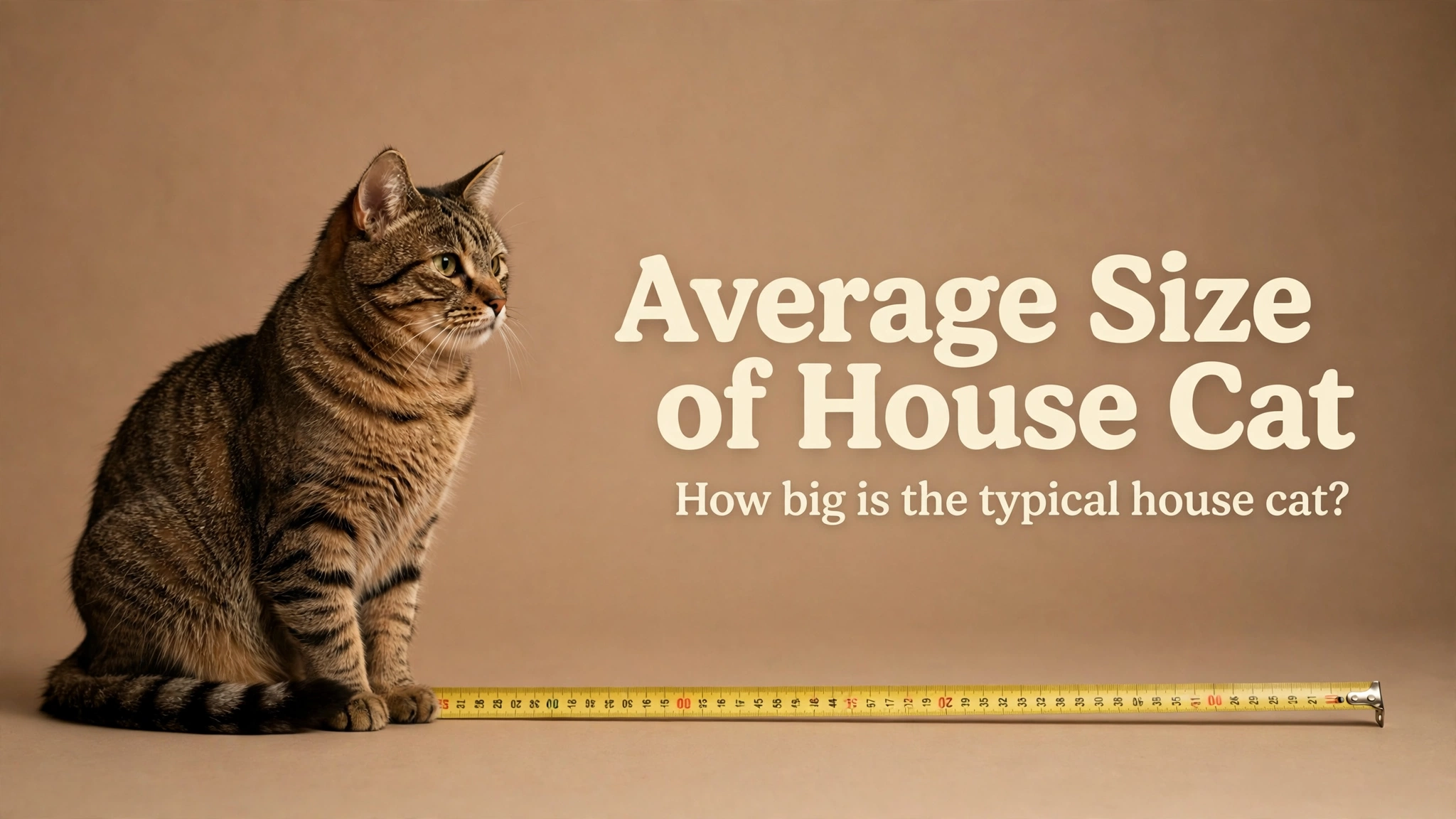
Your cat curls into a ball small enough to fit in a shoebox, then stretches out across the whole sofa an hour later. It is no wonder owners ask how big a house cat should be. The short answer is simple: a healthy adult house cat usually weighs 8 to 10 pounds, measures 18 to 20 inches from nose to tail base, and stands 9 to 10 inches tall at the shoulder. That is the middle of the range for the average size of house cat owners see every day, and most mixed breed cats land close to it.
This guide gives you the full picture: the weight, length, and height ranges, how males and females differ, how kittens grow month by month, and how common breeds compare. You will also learn a simple way to measure your own cat at home, and how to tell a big cat from an overweight one. The domestic cat comes in many shapes, but the average is easier to picture than you might think.
The Average House Cat at a Glance
Most healthy adult house cats fall inside a fairly narrow band of numbers. Weight runs 8 to 10 pounds for the typical mixed breed cat, with 8 to 12 pounds still counted as healthy for many cats. Body length runs 18 to 20 inches from the tip of the nose to the base of the tail. Add the tail and the total stretches to about 27 to 33 inches. Height at the shoulder runs 9 to 10 inches, and the tail alone adds 9 to 12 inches.
These numbers describe the ordinary mixed breed cat, the domestic shorthair or longhair that makes up most pet cats. Purebred cats can sit well outside this band, which is why the breed table later in this guide matters. If your cat sits inside these ranges and holds a steady weight, it is very likely right where it should be.
Measurement
Average adult house cat
Weight
8 to 10 pounds
Body length (nose to tail base)
18 to 20 inches
Total length (with tail)
27 to 33 inches
Height at shoulder
9 to 10 inches
Tail length
9 to 12 inches
How Much Does the Average House Cat Weigh?
Weight is the number owners ask about first, and the answer depends on frame as much as on breed. A healthy adult house cat usually weighs 8 to 10 pounds. Vets often stretch the healthy range to 8 to 12 pounds for mixed breed cats, because a tall, long cat can carry more weight than a short, compact one without being fat.
Think of weight as a range, not a single target. A small framed female may be perfectly healthy at 7 pounds, while a big framed male may be perfectly healthy at 12 pounds. What matters most is that the weight stays steady over time and the body shape looks right, which we cover in the section on telling big from overweight.
Indoor cats often weigh a little more than outdoor cats, because they move less and eat on a regular schedule. That does not make an indoor cat unhealthy by itself, but it does mean portions matter more when a cat spends the whole day inside.
How Long and How Tall Is the Average House Cat?
Length is measured from the tip of the nose to the base of the tail, and for the average house cat that runs 18 to 20 inches. The tail is left out of this number because tails vary so much between cats. Add the tail back in and most cats measure 27 to 33 inches from nose to tail tip. The tail itself is usually 9 to 12 inches long.
Height is measured at the shoulder, from the floor to the top of the shoulder blades, and the average is 9 to 10 inches. That is just under the height of a standard sheet of printer paper stood on end.
It helps to picture these numbers next to things you know. A house cat stretched out is close to the length of a large pizza box, and its body alone is about as long as a laptop keyboard is wide. When a cat curls up, it can look half that size, which is why so many owners are surprised the first time they measure.
Male vs Female: How Much Bigger Are Boy Cats?
In almost every breed, male cats grow larger than females. The gap is not huge, but it is steady. Adult males usually weigh 9 to 12 pounds, while adult females usually weigh 7 to 10 pounds. That puts the average male about 1 to 2 pounds heavier than the average female, and usually an inch or so longer and a little taller at the shoulder.
Neutering changes the picture a little. A neutered male or a spayed female burns fewer calories than an unaltered cat, so the same amount of food can slowly add weight. The cat does not grow taller after neutering, but it can grow wider if portions stay the same. Vets usually suggest cutting food by a small amount after the surgery and checking weight every few weeks.
Sex is only one piece of the puzzle. A large female from a big breed can easily outweigh a small male from a small breed, so always compare your cat with its own breed range first.
From Tiny Kitten to Full Grown: The Growth Timeline
A newborn kitten weighs only 3 to 4 ounces, about as much as a small apple. From there growth is fast. A simple rule owners use is one pound per month for the first six months, so a four month old kitten often weighs close to four pounds. Kittens also gain about half an ounce to an ounce a day in the first weeks of life.
By six months most kittens weigh 5 to 7 pounds and look like small adults, even though they still have growing to do. Most mixed breed cats reach close to their adult weight by 12 months and stop growing between 12 and 18 months. Large breeds take longer: a Maine Coon or a Ragdoll can keep filling out until it is three to five years old.
If your kitten gains weight in a steady line and stays active and playful, it is growing well. A kitten that stops gaining, loses weight, or grows much faster than the table below is worth a vet check.
Age
Typical weight
What is happening
Birth
3 to 4 ounces
Eyes closed, fully dependent on mother
8 weeks
About 2 pounds
Weaned, ready for a new home
4 months
About 4 pounds
Growing fast, very playful
6 months
5 to 7 pounds
Looks like a small adult
12 months
8 to 10 pounds
Near adult size for most cats
12 to 18 months
Adult weight
Growth stops for most mixed breed cats
Breed by Breed: How Common Breeds Compare to the Average
Breed moves the average more than any other factor. A Singapura adult can weigh half as much as a Maine Coon adult, and both are healthy. The table below shows where common breeds sit next to the average house cat, so you can see whether your cat is small, typical, or large for its breed.
Most pet cats are mixed breed domestic shorthairs or longhairs, and they cluster around the average: 8 to 12 pounds. Purebred cats spread out from there. If your cat is a breed with a wide range, like the Ragdoll, remember that males sit at the top of the range and females at the bottom. For a closer look at the heavy end of the scale, see our guide to the biggest domestic cat breeds.
Breed
Adult weight
Compared with the average
Singapura
4 to 8 pounds
Smallest of the common breeds
Siamese
8 to 12 pounds
Close to the average, slim build
Domestic Shorthair
8 to 12 pounds
The average house cat
American Shorthair
10 to 15 pounds
A little above the average
British Shorthair
10 to 18 pounds
Stocky and heavy for its length
Ragdoll
10 to 20 pounds
Large, slow to finish growing
Maine Coon
13 to 20 pounds
Well above the average
Why Some House Cats Stay Small and Others Grow Past the Average
Genetics sets the limit. A cat inherits its frame from its parents, so a kitten from small parents usually stays small, and a kitten from large parents usually grows large. If you know the parents, they are the best clue to adult size you will ever get.
Food in the first six months matters too. A kitten that eats well during that fast growth period reaches its full genetic size. A kitten that goes hungry early in life may stay smaller than its genes intended, even with good food later. This is common in rescued strays that had a rough start.
Health plays a part as well. Worms, long illness, or a health problem during kittenhood can slow growth. On the other side, a cat that eats too much does not grow taller or longer. It only grows wider, which is fat, not size. Exercise shapes muscle, and an active cat carries its weight as lean muscle instead of soft fat.
How to Measure Your Cat at Home
You do not need special tools to measure your cat. A soft sewing tape, a bathroom scale, and a helper to hold the cat still are enough. Measure when your cat is calm, and give a treat after each step so the next one goes easier.
Length: lay the tape along your cat’s back from the tip of the nose to the base of the tail, where the tail meets the body. Do not include the tail. Write the number down.
Height: stand your cat on all fours and measure from the floor to the top of the shoulder. This is the trickiest step, because cats rarely stand still, so try it while your cat is eating from a bowl on the floor.
Weight: step on the bathroom scale holding your cat, note the number, then step on alone and subtract. This subtraction method is far more accurate than trying to keep a wriggling cat on a small scale.
Girth: wrap the tape gently around the chest just behind the front legs. Girth helps your vet judge body condition, and it is handy when you buy a harness or a carrier.
Measure once a month and keep the numbers in a notebook or on your phone. A slow change over months is normal. A sudden change is the kind of thing worth showing your vet.
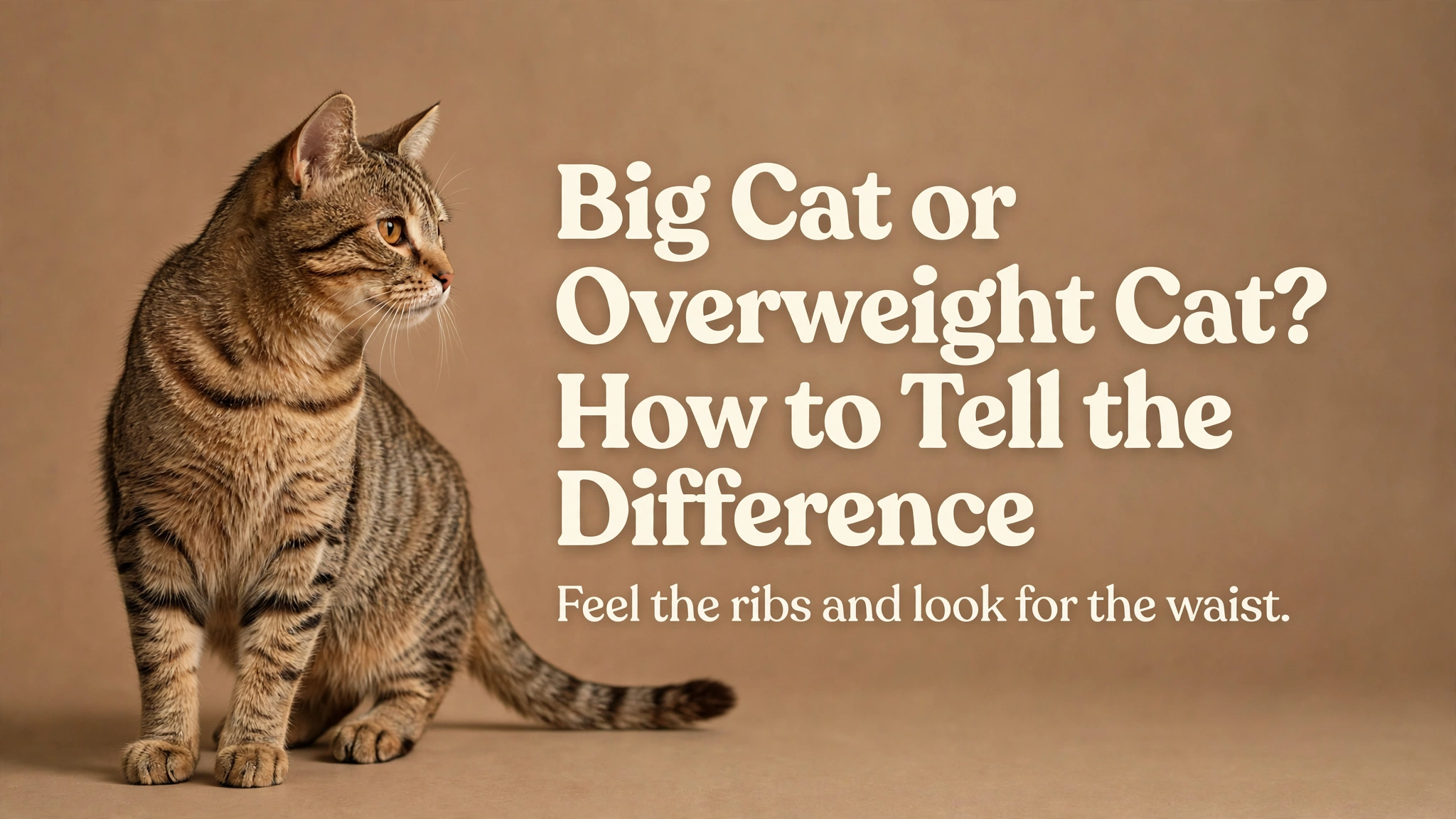
Big Cat or Overweight Cat? How to Tell the Difference
This is the question that worries owners most, and the scale alone cannot answer it. A 14 pound cat can be a healthy large breed, or it can be an average cat carrying four extra pounds. The body tells the truth, and three quick checks sort it out.
First, feel the ribs. Run your hands along your cat’s sides with light pressure. You should feel the ribs easily, like the bones on the back of your hand, but you should not see them poking through the coat. If you have to press hard to find them, your cat is carrying extra fat.
Second, look from above. A healthy cat has a waist you can see, a gentle inward curve behind the ribs. If the body runs straight from shoulders to hips with no curve, or bulges outward, the cat is overweight.
Third, look from the side. The belly should tuck upward behind the ribs. A belly that hangs low and swings when the cat walks usually means extra weight. Do not confuse this with the primordial pouch, the loose flap of skin under the belly that even slim cats have. The pouch is normal. A sagging, fat filled belly is not.
Vets score this on a 1 to 9 scale called the body condition score, where 4 to 5 is ideal. A score of 4 to 5 means ribs you can feel, a visible waist, and a belly that tucks up. If your checks point to a score of 6 or higher, talk to your vet about a food plan before the extra weight turns into health trouble.
When Your Cat’s Size Is a Reason to Call the Vet
Most size differences are normal, but a few are warning signs. Call your vet if your cat loses or gains more than about 10 percent of its body weight over a few months without a change in food or activity. For a 10 pound cat, that is about one pound, which is easy to miss if you are not weighing regularly.
A cat that eats well but keeps losing weight needs a check too. An overactive thyroid is a common cause in older cats, and it can be treated once it is found. A belly that swells quickly, trouble breathing, or a kitten that stops growing are also reasons to book a visit soon rather than waiting.
Bring your monthly weight notes to the visit. A short list of dates and weights helps your vet see the pattern at a glance, and it often points straight to the cause.
Conclusion: What Average Really Means for Your Cat
The average size of house cat owners live with is easy to remember: 8 to 10 pounds, 18 to 20 inches long, and 9 to 10 inches tall at the shoulder. That is the middle of the range, not a rule every cat must follow. Breed, sex, age, and frame all move the numbers, and a healthy cat can sit a little above or below the average without any problem.
What matters more than the average is your own cat’s pattern. Measure once a month, feel the ribs, look for the waist, and watch for sudden changes. If the weight holds steady and the body shape looks right, your cat is very likely fine, whatever the scale says.
Frequently Asked Questions About the Average Size of a House Cat
How much does the average house cat weigh?
Most healthy adult house cats weigh 8 to 10 pounds. Vets often count 8 to 12 pounds as healthy for mixed breed cats, because frame size and breed move the number. Females usually weigh 7 to 10 pounds, and males usually weigh 9 to 12 pounds.
How long is the average house cat?
A house cat usually measures 18 to 20 inches from nose to tail base. With the tail included, the total length runs 27 to 33 inches, and the tail itself is usually 9 to 12 inches long.
How tall is the average house cat?
Most house cats stand 9 to 10 inches tall at the shoulder. That is just under the height of a standard sheet of printer paper stood on end. Males are usually a little taller than females.
Are male cats bigger than female cats?
Yes, in almost every breed. Adult males usually weigh 9 to 12 pounds, while females usually weigh 7 to 10 pounds, so males run about 1 to 2 pounds heavier and an inch or so longer.
At what age is a cat fully grown?
Most mixed breed cats reach their adult size between 12 and 18 months. Large breeds such as the Maine Coon and the Ragdoll keep growing longer and may not reach full size until they are three to five years old.
Is 15 pounds heavy for a house cat?
It depends on the breed and frame. For an average mixed breed cat, 15 pounds is usually above the healthy range. For a large breed such as a Maine Coon or a Ragdoll, 15 pounds can be perfectly normal. Check the ribs and the waist to judge.
How can I tell if my cat is overweight or just big?
Feel the ribs with light pressure, look for a waist from above, and check for a belly tuck from the side. If the ribs are easy to feel and the waist is visible, the cat is big. If the ribs hide under fat and the waist is gone, the cat is overweight.
What is the smallest house cat breed?
The Singapura is the smallest common breed. Adults usually weigh 4 to 8 pounds and stand about 6 to 7 inches tall at the shoulder. A full grown Singapura can look like a kitten next to an average house cat.
Bella Barker is a pet food safety writer with 10+ years of experience. She researches what dogs and cats can (and can't) eat and turns it into simple, practical guides for everyday pet parents. 🐶🐱
A Scottish cat walks into a room and quietly takes it over. The round face, the big eyes, and the small ears folded forward give this cat an owl look that stops people in their tracks. It is one of the most photographed cats on the internet, and one of the most misunderstood. This guide…
Most house cats weigh between 8 and 12 pounds, and they fit neatly on your lap. Then there are the giants. Some domestic cats grow so large that they weigh as much as a small dog, stretch close to four feet long, and need a litter box built for a much bigger animal. If you…