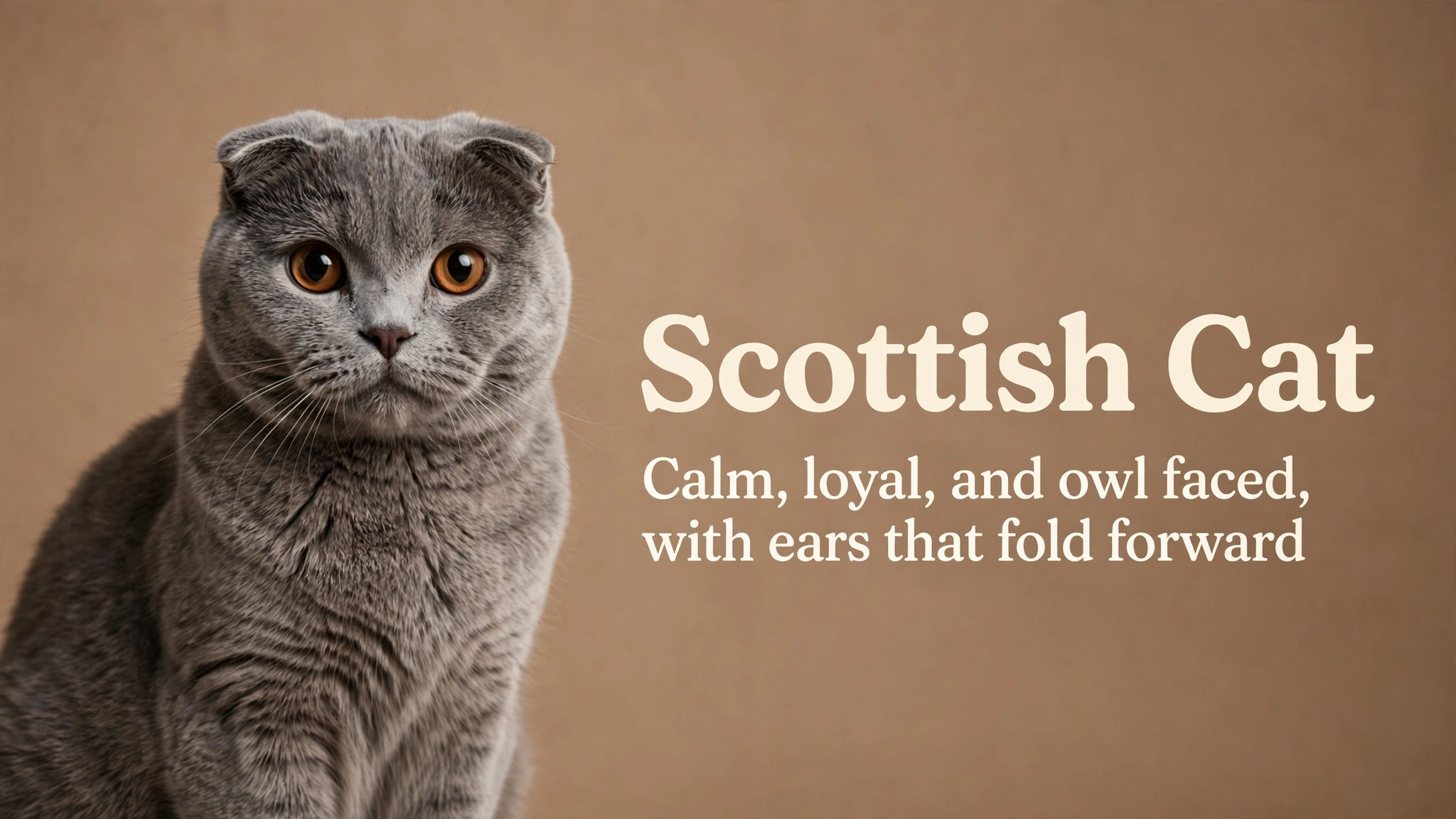
A Scottish cat walks into a room and quietly takes it over. The round face, the big eyes, and the small ears folded forward give this cat an owl look that stops people in their tracks. It is one of the most photographed cats on the internet, and one of the most misunderstood.
This guide covers the whole breed family: the folded ear Scottish Fold, the straight eared Scottish Straight, and the long coated Highland Fold, also called the Scottish Longhair. You will learn where the fold came from, what it does to the joints, how the temperament really feels day to day, and what one costs to buy and to keep. The health facts here are plain and honest, because the same gene that folds the ears affects cartilage all over the body, and a good decision needs that truth up front.
At a Glance: This Breed in 60 Seconds
Fact
Detail
Origin
Scotland, 1961, from a barn cat named Susie
Weight
6 to 13 pounds, males usually heavier
Lifespan
11 to 15 years with good care
Coat
Short or long, dense and plush, many colors
Temperament
Calm, loyal, quiet, people focused
Activity
Moderate, short gentle play sessions
Shedding
Moderate, more in spring and autumn
Good with
Children, other cats, calm dogs
Apartment fit
Very good, a quiet indoor cat
Big health note
The fold gene causes a joint condition called osteochondrodysplasia
Kitten price
About $1,000 to $3,000 from a breeder, adoption $100 to $300
Fold, Straight, or Longhair: Untangling the Names
The names around this breed confuse almost everyone at first, so here is the simple map.
A Scottish Fold has folded ears. A Scottish Straight has straight, upright ears and the same round face and sweet nature, but no fold gene at work. A Highland Fold is a Scottish Fold with a long coat. A Scottish Longhair is the same long coated cat, just under a different label. Some registries call the long coated straight eared cat a Highland Straight.
All of these cats belong to one family. The differences come down to two things: ear shape and coat length. A litter can hold folded kittens and straight kittens side by side, and the straight eared kittens are not mistakes. Breeders need them, because a folded cat should only ever be bred to a straight eared partner, never to another folded cat. That rule keeps the joint condition from getting worse in the next generation.
When you shop for one of these cats, ask which of the four you are looking at. A seller who calls every kitten a Scottish Fold, folded or not, is either careless or hiding something.
Where the Folded Ear Came From: Susie and the 1961 Barn
Every folded ear cat in this breed traces back to one white barn cat named Susie, found on a farm near Coupar Angus in Scotland in 1961. A shepherd named William Ross noticed her unusual ears and took two of her kittens home. Those kittens carried the fold forward, and the breed grew from there.
At first the breed was called the Lop. In 1966 the name changed to Scottish Fold. Breeders crossed the early Folds with British Shorthairs and ordinary domestic shorthairs to widen the gene pool and steady the round, cobby body shape we know today.
The breed is recognized by The International Cat Association and the Cat Fanciers Association. It is not recognized by the Governing Council of the Cat Fancy in the United Kingdom or by FIFe in Europe, and the reason is the health condition tied to the fold gene. That split is worth knowing before you buy, because it tells you the debate is real and long running, not a rumor.
The Fold Gene and the Joint Truth No Breeder Should Skip
Kittens are born with straight ears. In kittens that carry the fold gene, the ears start to bend forward and down at about three to four weeks old. The bend comes in degrees: a single fold is a loose bend, a double fold lies flatter, and a triple fold presses the ear tight against the head like a cap.
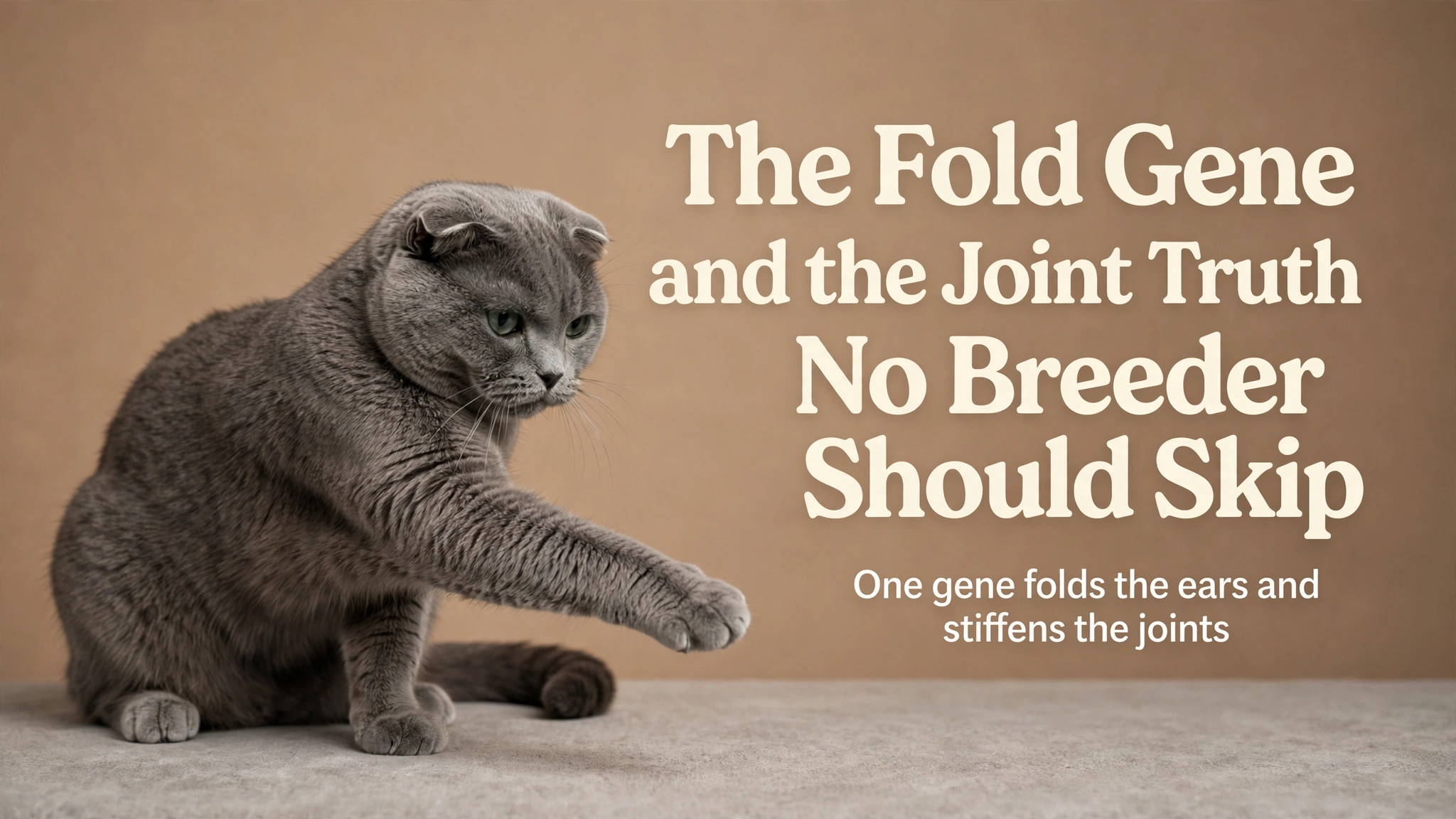
The gene behind the fold is a dominant change in a gene called TRPV4. It changes how cartilage forms, and cartilage is not only in the ears. It is in the joints, the tail, the spine, and the legs. So the same change that makes the ears fold also causes a painful bone and cartilage condition called osteochondrodysplasia, often shortened to SFOCD.
Here is the part no honest guide can soften: every folded ear cat carries this condition to some degree. It is not a risk that some Folds escape. It is built into the fold itself. The condition causes progressive arthritis, stiff and swollen joints, a thick and inflexible tail, and in severe cases fused joints and lameness. Signs can show up young, sometimes before a cat is six months old, and there is no cure.
Cats with two copies of the gene, usually the kittens of two folded parents, get hit hardest and earliest. Cats with one copy often have milder, slower disease, and may live comfortably for years with good care. Pain management, a lean body weight, gentle daily movement, joint supplements, and regular vet checks can help a lot, but they manage the condition, they do not remove it.
This is why the breeding rule matters so much. A folded cat must only be bred to a straight eared partner. A breeder who pairs two folded cats together is putting kittens at high risk of severe disease, and you should walk away from that breeder. The same goes for any seller who will not talk about the joint condition, or who calls it a myth.
If you already love the breed but the health picture worries you, look at the Scottish Straight. It has the same round face, the same calm nature, and the same plush coat, with upright ears and no fold gene at work. It is the same family without the joint burden. You can read the full background on the Wikipedia page for the Scottish Fold before you decide.
What This Breed Looks Like (Beyond the Ears)
Take away the ears and this is still a striking cat. The head is round, the cheeks are full, the eyes are large and round, and the body is medium sized and compact, with a thick tail that tapers to a rounded tip. The coat is dense and plush and stands away from the body, soft to the touch like a stuffed toy.
Males usually weigh 9 to 13 pounds and females 6 to 9 pounds. The breed stands about 8 to 10 inches tall at the shoulder. Colors run wide: white, black, blue, cream, red, silver, and many more, in solid, tabby, bicolor, tortoiseshell, and colorpoint patterns. A few colors are not accepted in the show ring, including chocolate, lavender, and the Himalayan pattern, but pet owners rarely need to care about that.
The long coated cats, the Highland Fold and the Scottish Longhair, carry the same shape under a flowing coat that needs more brushing. Their tails look fuller and their cheeks look even rounder under the extra fur.
Temperament: The Quiet Shadow Who Sits Like a Buddha
A Scottish cat is a calm, loyal companion that likes to be near its people without demanding constant attention. It will follow you from room to room, settle beside you on the sofa, and watch whatever you are doing with quiet interest. Owners often call them velcro cats, because the cat sticks close all day.
The voice is small and soft, and this breed uses it sparingly. It is not a chatty cat. It asks for food or a door with a quiet chirp and then goes back to watching the world.
The famous party trick is the Buddha sit. One of these cats will sit upright on its hind legs, front paws resting in its lap, looking like a tiny person meditating. They also stand on their hind legs like little prairie dogs when something catches their interest, and they love to lie flat on their backs or stretch out in odd, relaxed poses. These habits are charming, and they are also a clue: a cat that stops doing them may be hurting.
With children, these cats are patient and gentle, as long as the children are taught to handle them softly and never to pull the tail or the legs. That matters more than usual here, because a sore tail or stiff joint hurts when it is grabbed. With other cats and calm dogs, they usually get along well, though other cats sometimes misread the folded ears as a sign of mood.
They do not do well left alone for long stretches. A cat left alone all day, every day, can grow bored and withdrawn. If your home is empty for ten hours a day, this may not be the right breed, or you may want to plan for a second cat as company.
Grooming by Coat: Short, Long, and Those Folded Ears
Grooming needs split by coat length, and it is the one place where the longhair cats ask for real work.
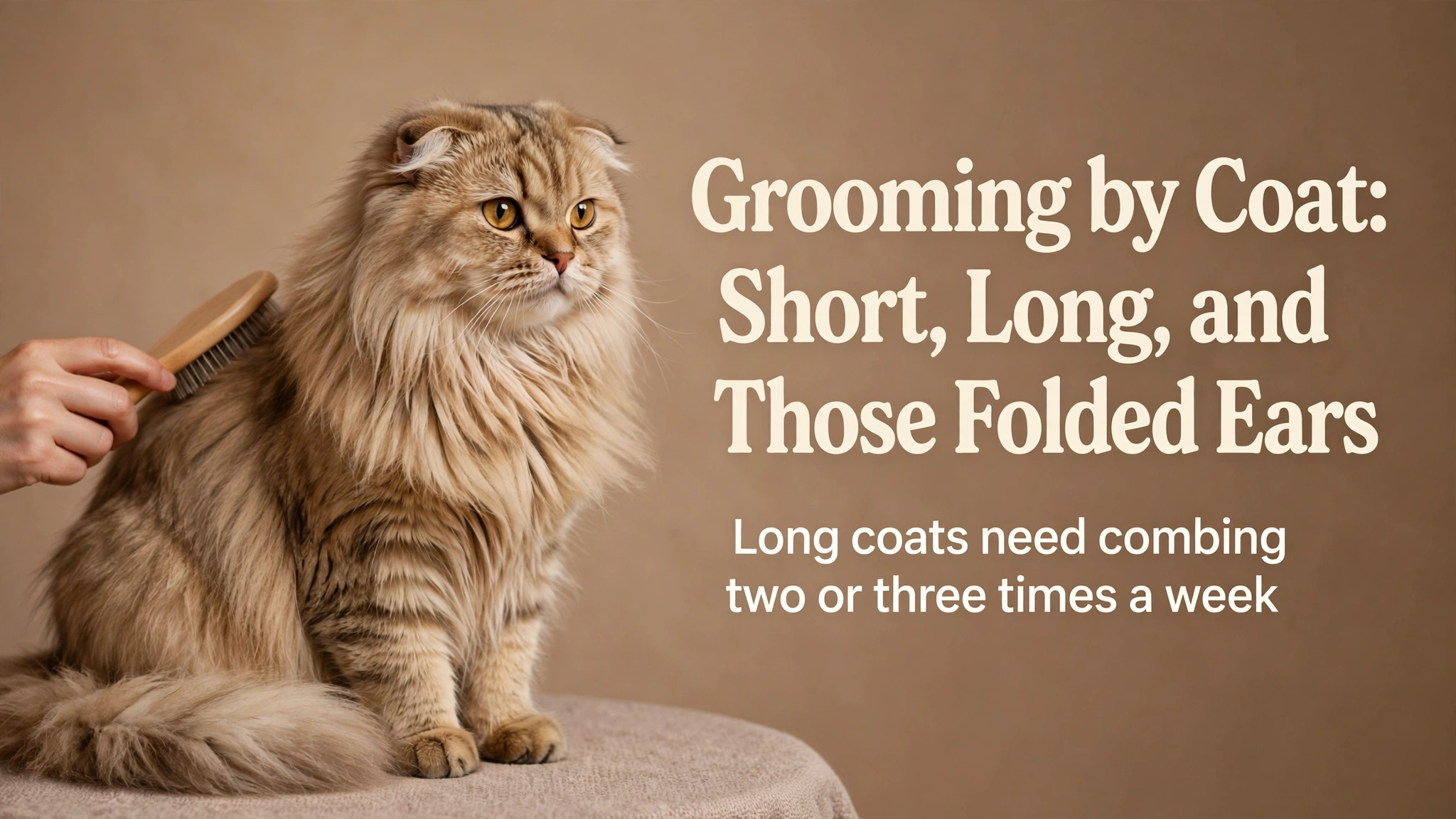
A short coated cat needs a weekly brush with a soft brush or a grooming glove. That is enough to remove loose hair, keep the coat shiny, and cut down on shedding around the house. A long coated cat, the Highland Fold or Scottish Longhair, needs combing two or three times a week with a wide tooth comb. Skip a week and mats form behind the ears, under the legs, and around the collar, and mats pull the skin and hurt.
The folded ears need a weekly check of their own. The fold traps wax, moisture, and debris, so the ear canal gets less airflow than an upright ear. Look inside gently once a week. If you see dark wax or smell a strong odor, clean the ear with a vet approved ear cleaner on a cotton ball, never a cotton swab deep in the canal. Redness, head shaking, or scratching at the ear means a vet visit, because ear infections are common in this breed.
Nails need a trim every two to three weeks, or whenever they start to snag on fabric. Teeth need brushing with cat safe toothpaste a few times a week, and a vet dental check once a year. Eyes need a quick wipe with a soft damp cloth when discharge collects in the corners.
One warning for bath time: only bathe when the coat is actually dirty or oily, and use a gentle cat safe shampoo. Most Scottish cats never need a regular bath.
Feeding and Keeping Weight Down to Protect the Joints
Food is not just about a shiny coat here. Extra weight loads sore joints, and for a breed where every folded cat carries a joint condition, keeping the cat lean is the single most useful thing you can do at home.
Feed a complete and balanced cat food that meets AAFCO standards, matched to the cat’s age, size, and activity level. Measure the portions with a cup instead of free feeding from a full bowl all day, because these calm cats will happily eat more than they burn. A mix of wet and dry food works well: wet food adds water to the diet, which supports kidney and urinary health, and dry food is easy to measure.
Treats should stay under ten percent of the daily calories. A few small treats for training or play are fine. Table scraps are not, because they add calories fast and can upset the stomach.
Watch the waistline once a month. You should be able to feel the ribs under a thin layer of fat, and the waist should tuck in when you look down at the cat from above. If the ribs are hard to find, talk to your vet about a feeding plan before the extra weight starts to show in stiff movement.
Kittens need kitten food until about twelve months old, then a switch to adult food. Senior cats, from about ten years on, may need a food with fewer calories and added joint support, and your vet can guide that change.
Play and Exercise: Gentle Games for Tender Joints
This breed needs about twenty to forty minutes of play a day, split into two short sessions. The trick is to keep the games low and gentle, because high jumps and hard landings hurt joints that are already fragile.
Wand toys dragged along the floor are perfect. Rolling balls, small toy mice, and gentle fetch games work well too, and many Scottish cats love to fetch and bring the toy back. Food puzzles and treat balls keep a clever cat busy and slow down fast eaters at the same time.
Set up the home for a cat that should not jump far. Low, wide cat furniture with ramps or steps beats a tall cat tree. Soft rugs under the favorite perches give soft landings. A scratching post, tall enough for a full stretch, keeps claws healthy and gives the cat a safe place to scratch.
Watch for the early signs of joint pain during play. A cat that stops jumping onto the sofa, walks with a short stiff step, or sits down mid game and refuses to move is not being lazy. It is likely hurting, and it needs a vet visit rather than a new toy.
Living With This Breed: Apartments, Kids, and Other Pets
This breed fits apartment life very well. It is quiet, it does not need a garden, and it is happy with a sunny window, a scratching post, and a person nearby. A one bedroom flat suits a Scottish cat as well as a big house does, as long as someone is home for a good part of the day.
With children, the match is good when the children are old enough to be gentle, or when an adult teaches them how to handle the cat. The rule is simple: stroke the back and the cheeks, never pull the tail, never grab the legs, and never pick the cat up by the front legs. A child who learns that rule gets a patient, loyal friend.
With other pets, introductions should be slow and calm. Let the new cat and the resident pet sniff each other through a closed door for a few days, then meet in short supervised sessions with treats on both sides. Most Scottish cats accept a calm dog or another cat within a week or two. A very loud, bouncy dog can stress a quiet Scottish cat, so a calm household works best.
Keep this cat indoors. The folded ears and the calm nature do not suit a roaming life, and traffic, other animals, and disease are real risks outside. An indoor cat with a window perch and regular play lives longer and stays healthier.
What This Breed Costs: Kitten Price and Yearly Care
A pet quality Scottish Fold kitten from a registered breeder usually costs between $1,000 and $3,000. Show quality kittens, or rare colors, can run $3,500 to $6,000 and up. Straight eared kittens, the Scottish Straights, usually cost less than their folded littermates. Adoption from a shelter or rescue usually costs $100 to $300 and often includes spay or neuter, first vaccines, and a microchip.
The first year costs more than the rest, because it holds the purchase price, the first vet visits, vaccines, spay or neuter, a carrier, a litter box, scratching posts, and food bowls. Plan for roughly $1,500 to $2,500 on top of the kitten price in that first year.
After that, a typical year runs about $2,000 to $2,500. Food is the biggest regular cost, then routine vet visits and vaccines, then litter and basic supplies. For this breed, budget extra for joint care. Pain management and joint support can add $500 to $2,000 a year if the joint condition needs treatment, and heart screening adds a few hundred dollars a year in some lines. Ear infections, when they happen, cost about $150 to $400 per episode to treat.
Over a thirteen year life, that adds up to roughly $30,000 or more. That number surprises people, but it is better to know it before you bring a kitten home than to learn it at the vet when the cat is already hurting.
Kitten or Adult: How to Choose One the Kind Way
If you decide on this breed, how you get the cat matters as much as which cat you get.
A good breeder will let you meet the mother cat, show you the home the kittens grow up in, and talk openly about the joint condition. Ask these questions before you pay anything: Do you ever breed two folded cats together? The answer must be no. Can I see the vet records for the parents? Can I see the kitten move, jump, and play? A kitten that already walks stiffly or refuses to jump is a warning sign. Will you take the cat back if it does not work out? A good breeder always says yes.
Be wary of a seller who will not show you the parents, who pushes you to decide fast, who sells kittens under eight weeks old, or who offers a folded kitten at a price far below the usual range. Those are signs of a kitten farm or a scam, and the kitten is the one who pays for it.
Adoption is a strong option, and it is often the kinder one. Breed specific rescues and shelters sometimes have Scottish cats, including adults whose ears and temperament are already known. An adult cat has two advantages: you can see how its joints move today, and you skip the guessing about how the ears will fold. Ask the shelter about the cat’s vet history, and if the cat has folded ears, ask whether a vet has checked its joints. You can also read our guide to the early signs of kidney disease in cats, since kidney checks are part of good senior cat care for any breed.
Conclusion: Is This Breed Right for You?
A Scottish cat is a calm, loyal, and quietly funny companion that fits apartments, families, and first time owners who want a gentle cat. The round face and the folded ears are real, and so is the charm. But the folded ears come with a joint condition that every folded cat carries, and that fact should sit at the center of your decision, not at the edge of it.
Choose this breed if you can give it a calm home, a lean body, gentle play, weekly ear checks, and regular vet care, and if you can accept that joint pain may need managing for years. Choose a Scottish Straight if you love the look and the nature but want to skip the fold gene. Or adopt an adult, where you can see the cat in front of you instead of guessing.
The kindest choice is an informed one. If you go in with open eyes, a Scottish cat can be a wonderful companion for a decade or more.
Frequently Asked Questions About Scottish Cats
Are Scottish Fold cats always in pain?
Every folded ear cat carries the gene behind osteochondrodysplasia, a cartilage and joint condition, but pain levels vary a lot. Cats with one copy of the gene often have mild, slow disease and live comfortably with good care, while cats from fold to fold breeding suffer more and earlier. Cats hide pain well, so a quiet Fold is not always a comfortable one. Watch for stiffness, reluctance to jump, and a stiff tail, and ask your vet about pain checks at every visit.
How much does a Scottish Fold kitten cost?
A pet quality kitten from a registered breeder usually costs $1,000 to $3,000, with show quality kittens reaching $3,500 to $6,000 and up. Adoption from a shelter or rescue usually costs $100 to $300. Budget about $2,000 to $2,500 a year after the first year, with extra set aside for joint care.
How long do Scottish cats live?
With good care, most Scottish cats live about 11 to 15 years. Straight eared Scottish Straights often live a little longer, around 13 to 17 years, because they do not carry the fold gene and its joint condition. Weight, vet care, and indoor living all help a cat reach the upper end of that range.
Are Scottish cats good with children?
Yes, when children are taught to handle them gently. These cats are patient and calm with children, but they should never have their tail or legs pulled, because sore joints hurt when grabbed. Teach children to stroke the back and cheeks, and to let the cat walk away when it wants space.
Do Scottish cats shed a lot?
They shed a moderate amount, with heavier shedding in spring and autumn. A weekly brush keeps a short coat under control, while a long coated Highland Fold or Scottish Longhair needs combing two or three times a week. They are not hypoallergenic, and no cat breed truly is.
What is the difference between a Scottish Fold and a Scottish Straight?
The difference is only the ears. A Scottish Fold has ears that bend forward and down because of the fold gene, while a Scottish Straight has upright ears and no fold gene. They share the same round face, the same calm temperament, and the same body shape. The Straight also avoids the joint condition tied to the fold gene.
Are Scottish Fold cats hypoallergenic?
No. No cat breed is hypoallergenic. Scottish cats shed like most coated cats and produce the same allergens as other cats. A short coat and regular brushing can reduce loose hair around the house, but they do not remove the allergen.
Can this breed live in an apartment?
Yes, this breed suits apartment life very well. It is quiet, calm, and happy indoors with a sunny window, a scratching post, and daily play. It does not need a garden. The main need is company, so a home where someone is around for much of the day works best.
Bella Barker is a pet food safety writer with 10+ years of experience. She researches what dogs and cats can (and can't) eat and turns it into simple, practical guides for everyday pet parents. 🐶🐱
Most house cats weigh between 8 and 12 pounds, and they fit neatly on your lap. Then there are the giants. Some domestic cats grow so large that they weigh as much as a small dog, stretch close to four feet long, and need a litter box built for a much bigger animal. If you…
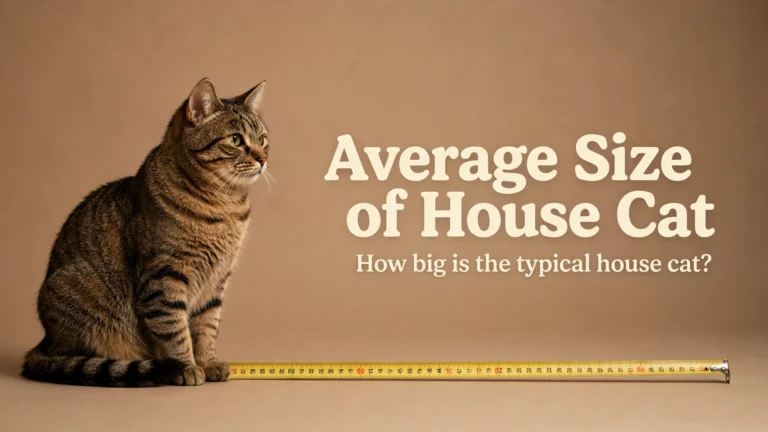
Your cat curls into a ball small enough to fit in a shoebox, then stretches out across the whole sofa an hour later. It is no wonder owners ask how big a house cat should be. The short answer is simple: a healthy adult house cat usually weighs 8 to 10 pounds, measures 18 to…



One Comment