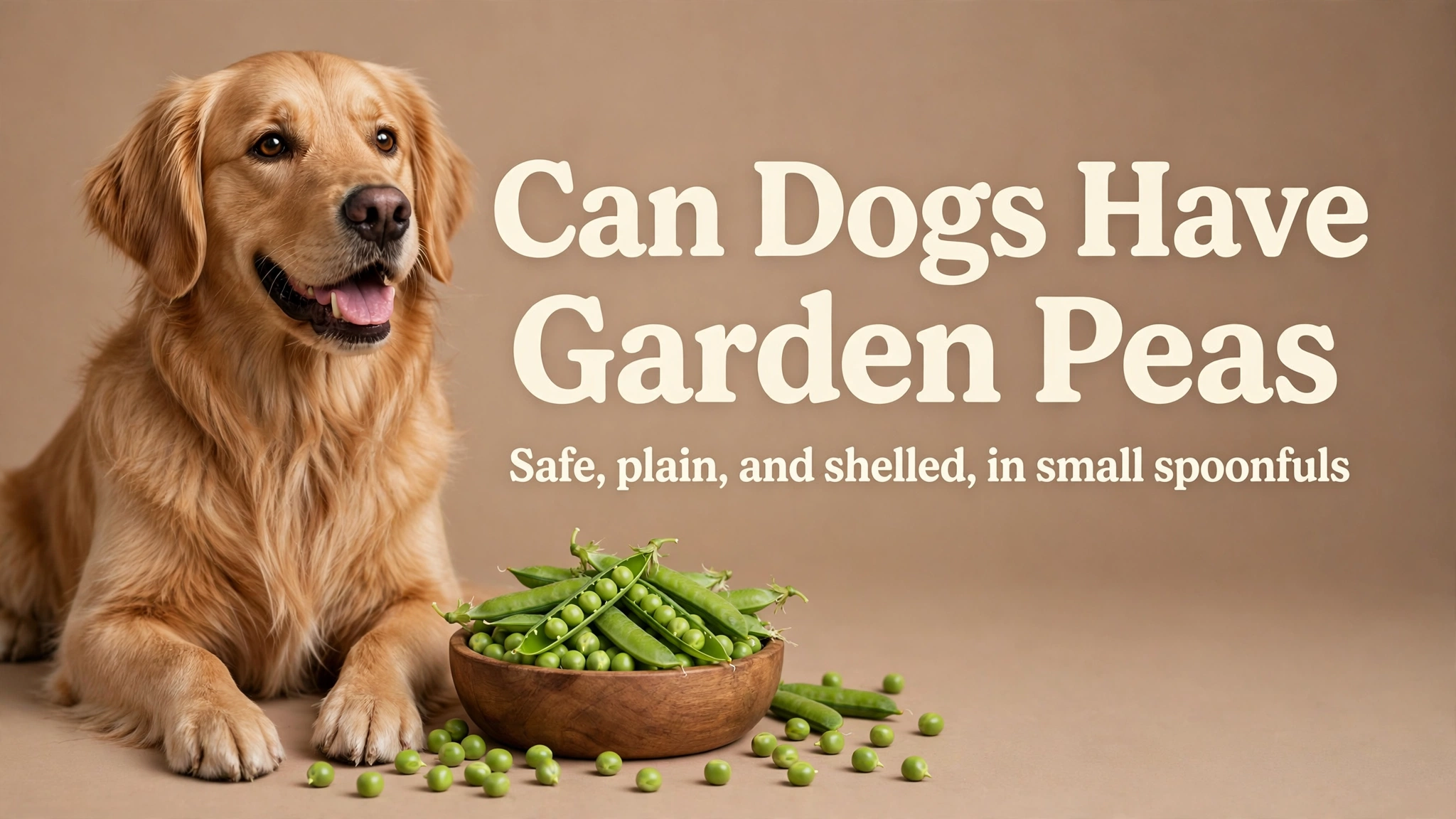
Your dog is staring at the peas on your plate, and the question lands before the first bite does: can dogs have garden peas? The short answer is yes. Plain garden peas, shelled and served in a small amount, are safe for most healthy adult dogs. They are low in calories, easy to prepare, and carry real nutrition in a very small package.
That short answer comes with a few conditions that matter. The peas must be plain, with no butter, salt, garlic, or onion anywhere near them. Garden peas must come out of their pods before your dog eats them. And the amount must stay small, because peas are a treat, not a meal. This guide covers which pea types are safe, how much to serve by your dog’s size, the dogs that should skip peas entirely, and the one question about peas in kibble that confuses a lot of owners.
The Short Answer: Yes, With One Shelling Rule
Can dogs have garden peas? Yes, in small plain servings, and only once the peas are out of the pod. The round green peas inside a garden pea pod are soft, sweet, and easy for a dog to chew and digest. The pod around them is a different story. Garden pea pods are tough, stringy, and hard to break down, so they can lodge in a small dog’s throat or sit undigested in the gut.
This shelling rule is what separates garden peas from their cousins. Snow peas and sugar snap peas have thin, tender pods that dogs can eat whole, though they still need to be cut into small pieces. Garden peas, also called English peas, are the ones that must always be shelled. If you remember one thing from this guide, make it this: the peas, yes; the garden pea pod, no.
Start small the first time. Offer three or four plain cooked peas and watch your dog for a day. If there is no gas, no loose stool, and no vomiting, your dog handled them fine, and you can work up to the portion in the size table below. Nothing else new should go into the bowl that day, so you know peas were the cause if anything changes.
Garden Peas, Snap Peas, and Snow Peas: Which Ones Count
The word pea covers several vegetables that look alike in the shop but behave differently in a dog’s bowl. Here is how each one lands.
Garden peas, also known as English peas or green peas, are the shelled kind. Botanically they are Pisum sativum, a cool season legume in the bean family, and the garden pea plant has been grown as food for thousands of years. You open the pod, tip out the round peas, and throw the pod away. Served plain and cooked or thawed, they are the safest pea for dogs, and they are the focus of this guide.
Snow peas are the flat, pale green pods you see in stir fries. The whole pod is edible, and dogs can eat it, but the pod is fibrous, so cut it into short pieces first. A whole snow pea pod can be hard for a small dog to chew through.
Sugar snap peas sit between the two. The pod is plump and sweet, and the peas inside are round. Dogs can eat the whole thing, but again, cut it into pieces for small dogs and cook it lightly to soften the pod.
Chickpeas and black eyed peas are cousins, not garden peas. Both are safe for dogs when they are fully cooked and served plain, but they are denser and heavier than garden peas, so keep the portion even smaller.
Wasabi peas and coated peas are the ones to refuse. They are covered in salt, spices, and flavourings, and some coatings contain onion or garlic powder. They belong nowhere near a dog’s bowl.
One more warning that catches garden owners off guard: sweet peas, the flowering plant sold as Lathyrus odoratus, are not food peas at all. Those ornamental sweet pea plants are toxic to dogs. If your dog chews garden flowers, check the plant name before you relax.
What Garden Peas Actually Give Your Dog
A spoonful of peas looks too small to matter, but the numbers are surprisingly strong. Per 100 grams of cooked green peas, your dog gets around 84 calories, about 5 grams of protein, and about 5.5 grams of fibre, along with vitamin K, vitamin C, several B vitamins including folate, and the minerals manganese, iron, zinc, potassium, and magnesium. That is a lot of nutrition for a food that costs almost nothing.
Fibre is the nutrient that does the most visible work. It keeps stools firm and regular, and it feeds the good bacteria in your dog’s gut. The trade off is that fibre also makes gas. A dog that is not used to fibre rich food will pay for a big first serving with a noisy evening, which is why the first portion should be tiny and the increase gradual.
Protein is the second benefit, and it needs an honest note. Peas do contain plant protein, and that is one reason so many dog food makers add them to kibble. But pea protein is not complete protein for a dog. It is low in methionine and cysteine, the amino acids dogs use to build taurine, and taurine matters for heart muscle. A spoonful of peas as a treat is fine. A diet built on peas as the main protein is not, and the kibble section below explains why that distinction matters.
Vitamin K supports healthy blood clotting, vitamin C supports the immune system, and the B vitamins help turn food into energy. None of these make peas essential. A dog on a complete balanced food already gets them. Peas are a bonus, not a requirement, and that is the right way to think about them.
Fresh, Frozen, Canned, and Dried: The Four Forms Ranked
Not every bag or tin of peas in your kitchen is equal. Here is the ranking, from best to worst for your dog.
Fresh garden peas are the best choice. Shell them, steam or boil them for two minutes until tender, let them cool, and serve. Fresh peas have no added salt and no preservatives, and you control everything about them.
Frozen peas are a close second, and they are the most practical option for most owners. They are picked and frozen at their peak, so their nutrition holds up well. Thaw them fully and bring them to room temperature before serving, or steam them for a minute. A frozen pea straight from the bag is rock hard and can be a choking risk for a small dog, and a whole bag of them frozen into a solid lump is worse, so always serve loose, individual peas.
Canned peas are the weakest pick. They sit in salty water with preservatives, and the sodium level is far higher than a dog needs. One or two rinsed canned peas will probably do no harm, but there is no reason to make them a habit when fresh or frozen peas are cheap and easy. If canned peas are all you have, rinse them well under running water first and keep the serving to a couple of peas.
Dried peas and split peas are safe only when they are cooked until completely soft and mashed. Hard dried peas are tough little pellets that can get stuck in a small dog’s throat. Cook them plain, with no salt and no stock cube, and let them cool before serving.
Portions by Dog Size: The Tablespoon Table
Peas count as treats, and all treats together should stay under 10 percent of your dog’s daily calories. That single rule keeps portions honest, because a tablespoon of peas carries about 8 calories, and those calories add up quietly across a day of snacks.
Use this table as a daily maximum, not a target. Start at the bottom of the range and only go higher if your dog’s stomach stays calm.
Dog size
Weight
Plain cooked garden peas per day
Small
21 to 30 pounds
2 teaspoons or less
Medium
31 to 50 pounds
1 tablespoon or less
Large
51 to 90 pounds
1 to 2 tablespoons or less
Extra large
Over 90 pounds
Up to 3 tablespoons or less
A teaspoon of peas is roughly 8 to 10 peas. A tablespoon is roughly 25 to 30 peas. If you are counting, count the peas, not the spoonfuls, because a heaped spoonful can easily be double a level one.
Two warnings sit behind this table. First, if peas already appear high on your dog’s kibble ingredient list, do not add more peas on top. Your dog is already getting pea content from the food, and extra peas push the total higher for no benefit. Second, if your dog is on a prescription diet, skip peas entirely unless your vet says otherwise. Prescription diets are balanced precisely, and treats outside the diet can undo that balance.
How to Serve Garden Peas Step by Step
Serving peas well takes about five minutes, and the routine is the same every time.
Shell the peas first if they are fresh from the garden or the market. Open each pod along its seam and tip the round peas into a bowl. Throw the pods in the compost, not the dog bowl.
Cook them lightly. Two minutes in boiling water or a quick steam is enough. The peas should be tender enough to squash between your fingers but not mushy. Cooking softens the fibre and makes the peas easier to digest, and it is the kinder choice for older dogs and dogs with sensitive stomachs.
Cool them completely. Peas straight from the pot are hot enough to burn a dog’s mouth, and dogs do not test food the way people do. Spread them on a plate for a few minutes before serving.
Serve them plain. No salt, no butter, no oil, no garlic, no onion, no stock. The peas on your dinner plate were cooked with seasoning, and that makes them a different food. Only plain peas count as safe.
Mash them for small or older dogs. A fork and ten seconds turns a spoonful of peas into a soft mash that is easy to swallow and easy to digest. This step also removes the small choking risk that whole round peas carry for tiny breeds.
Mix them in or serve them alone. A spoonful stirred into your dog’s regular food works well, and a few peas in a clean dish work just as well as a training reward. The first time, serve a single pea and watch for a day, then build up slowly.
Frozen Peas as a Summer Treat and Training Reward
Here is a use for peas that most guides skip, and it is the one your dog will like best. On a hot day, a few thawed frozen peas make a cool, low calorie snack, and a frozen pea handed out one at a time makes an excellent training reward for small dogs.
Trainers like peas for the same reason they like pea sized cubes of cheese: the reward is small, soft, and easy to swallow, so the dog stays focused on the next repetition instead of chewing for a minute. A pea carries about a third of a calorie, so you can pay for twenty repetitions of sit and stay without blowing the treat budget. Compare that with a commercial biscuit, which can carry 25 calories or more, and the advantage is clear.
The summer angle works too. On a warm afternoon, scatter a spoonful of thawed peas on a cool tile floor or float a few in a shallow bowl of cold water. Your dog gets a cooling game and a snack at the same time. Just keep the peas loose and individual. A clump of peas frozen solid is a choking risk, and a whole frozen pea is too hard for a small dog to chew safely.
Use peas for the easy repetitions and save the high value rewards, like a piece of plain cooked chicken, for the hard moments: recall practice, vet visit desensitization, and the first nail trim. Peas are a workhorse treat, not a jackpot treat, and that is exactly what makes them useful every day.
Peas in Your Dog’s Kibble: The DCM Question
This is the part of the pea story that most short guides leave out, and it is the part worth understanding properly. There are two different pea conversations, and they have different answers.
The first conversation is the treat conversation. A spoonful of plain peas as a snack is safe for most dogs. Nothing in the research changes that.
The second conversation is the ingredient conversation. Over the past several years, peas became one of the most heavily used ingredients in commercial dog food, especially in grain free formulas, where peas and lentils often replace grains as main ingredients. In 2018, the United States Food and Drug Administration began looking into reports of dilated cardiomyopathy, a disease where the heart muscle weakens and stretches, in dogs eating certain diets. More than 90 percent of the diets in those reports were grain free, and 93 percent contained peas or lentils as main ingredients.
That is an association, not a proven cause, and the distinction matters. A 2021 study that compared implicated and non implicated diets found peas were the ingredient that most separated the two groups. But no single cause has been confirmed, research is ongoing, and many factors can contribute to heart disease. A later feeding study found that healthy dogs eating a diet with up to 45 percent pulse ingredients showed no change in heart function. The picture is genuinely unresolved.
What should you do with that uncertainty? Three practical things. First, keep peas as a treat, not a staple. A spoonful in the bowl is a different thing from peas as the main protein in the food. Second, if your dog eats a grain free food with peas high on the ingredient list, ask your vet whether that food still makes sense for your dog, especially if your dog is a breed prone to heart disease. Third, watch for the warning signs that always deserve a vet visit: coughing, tiring quickly on walks, fainting, or fast breathing at rest. Those signs matter whatever your dog eats.
The pea question in kibble is a question about proportions. Small amounts are fine. Large amounts, meal after meal, are where the honest answer becomes “we do not know yet”, and that is a good reason to let your vet into the decision.
Purines: Why Dalmatians and a Few Other Breeds Should Skip Peas
Peas contain purines, natural compounds that break down into uric acid in the body. For most dogs, that is no problem at all. The kidneys filter uric acid out and life goes on. For a small group of dogs, it is a real problem, and this is the rule that catches owners by surprise.
Dalmatians are the breed to know. They carry a genetic difference in how they process uric acid, which leaves them prone to forming urate crystals and stones in their urine. Bulldogs and Black Russian Terriers share a similar tendency. For these breeds, high purine foods like peas, lentils, spinach, and organ meats are best limited or avoided, and only a vet should make that call.
Dogs with kidney disease belong in the same careful group. Damaged kidneys struggle to filter the extra uric acid and minerals that peas add, and kidney diets are tightly controlled for a reason. A dog with a history of bladder stones should also skip peas unless a vet says otherwise.
This is not a reason for most owners to worry. If your dog is a healthy Labrador, Beagle, or mixed breed with no kidney history, purines in a spoonful of peas are not a concern. But if your dog is a Dalmatian, a Bulldog, or a dog with any kidney or urinary history, peas are one of the foods to raise with your vet before the first serving.
Dogs That Should Skip Peas Entirely
Most healthy adult dogs can have a few plain peas without trouble. A few groups should sit this one out.
Dogs with kidney disease should skip peas. The purines and minerals add work for kidneys that are already struggling, and kidney diets are built to limit exactly that load.
Dogs with a history of urate bladder stones should skip peas too, for the same purine reason. Stones are painful and often need surgery, and no treat is worth that risk.
Puppies under three months have still maturing digestion, so stick to puppy formulated food and treats. Older puppies can try a few plain cooked peas, but treats are not a priority at that age.
Dogs with sensitive stomachs or digestive disorders may find that extra fibre makes things worse, not better. If your dog already deals with regular loose stools, peas are a poor choice of treat.
Dogs on prescription diets should not get peas or any other food outside the diet unless the vet approves it. The diet is doing a medical job, and extras can interfere with it.
If you are unsure about peas for your own dog, leave them out of the bowl and ring your vet for a quick yes or no.
If Your Dog Ate the Whole Bowl
Dogs counter surf, and dogs raid gardens. Here is how to handle the common pea situations calmly.
If your dog ate too many plain peas, expect possible stomach upset within a few hours. Gas, bloating, and loose stool are the usual signs. One episode of loose stool in an otherwise normal acting dog can be managed at home. Offer water, skip one meal, then return to small bland meals. Call your vet if vomiting or diarrhea repeats, if your dog refuses food for more than a day, or if you see lethargy or a swollen, painful belly.
If your dog ate peas cooked with onion or garlic, for example peas from a finished dish or a stir fry, call your vet. Describe the dish and how much went missing. Onion and garlic damage red blood cells in dogs, and the risk is dose related, so your vet needs the details to judge it. Watch for vomiting, weakness, or pale gums in the hours after.
If your dog ate wasabi peas or coated peas, call your vet as well, especially if the coating contained onion or garlic powder. The salt and spice load alone can cause vomiting and diarrhea, and the flavourings add a real risk on top.
If your dog raided the garden and ate pea plants, do not panic. The garden pea plant itself is not toxic to dogs, shoots and all, though a serious grazing session on fibrous plant matter can end in vomiting or diarrhea. The danger in the garden is the ornamental sweet pea, a different plant with a similar name, so check what is actually growing before you relax.
Conclusion: The Bottom Line on Garden Peas for Dogs
Can dogs have garden peas? Yes, and the rule is simple enough to remember. Shell them, serve them plain, keep the serving to a spoonful or less, and count them inside the treat budget. Fresh or frozen peas are the best forms, canned peas are the weakest pick, and seasoned peas from your dinner plate are a firm no. Most healthy adult dogs can enjoy peas as an occasional treat or a training reward, and a frozen pea on a hot day is one of the cheapest cooling snacks you will find.
Two exceptions stay in mind. Dalmatians, Bulldogs, and dogs with kidney disease or bladder stones should skip peas because of purines, and any dog on a prescription diet should only eat what the vet approves. The kibble question is the other one to carry with you: peas as a treat are settled science, while peas as a main ingredient in grain free food is still an open question, and your vet is the right person to help you read your dog’s food label. For another dog treat question with a calm honest answer, see our guide on mild cheddar cheese for dogs: mild cheddar cheese.
Frequently Asked Questions About Garden Peas for Dogs
Can dogs have garden peas every day?
Yes, a small daily spoonful is fine for most healthy dogs, as long as it fits inside the treat budget of 10 percent of daily calories. Keep the serving to the size table in this guide, and skip days if your dog’s stomach seems unsettled.
Do garden peas need to be shelled before dogs eat them?
Yes. Garden pea pods are tough, stringy, and hard to digest, and they can be a choking risk, especially for small dogs. Always shell garden peas and throw the pods away. Snow peas and sugar snap peas have softer pods that dogs can eat, cut into small pieces.
Can dogs eat frozen peas straight from the freezer?
It is better not to. A frozen pea straight from the bag is rock hard and can be a choking risk for a small dog. Thaw the peas fully and bring them to room temperature first, or steam them for a minute. Serve them loose and individual, never frozen into a solid clump.
Can dogs eat canned peas?
It is better not to. Canned peas sit in salty water with preservatives, and the extra sodium is not good for dogs. Choose fresh or frozen peas instead. If canned peas are all you have, rinse them well and keep the serving to a couple of peas.
Can puppies eat garden peas?
Puppies over three months can try a few plain cooked peas as a test, then watch for 24 hours. Very young puppies under three months should stick to puppy food and puppy formulated treats while their digestion is still maturing.
Can dogs eat pea pods?
Garden pea pods should not be fed to dogs, because they are tough and can be a choking hazard. Snow pea and sugar snap pods are softer, but cut them into small pieces before serving, and cook them lightly to soften the fibre.
Are peas bad for dogs with kidney disease?
Peas can be a problem for dogs with kidney disease, because they contain purines that break down into uric acid, which struggling kidneys have to filter out. Dogs with kidney disease or a history of urate bladder stones should skip peas unless a vet says otherwise. Dalmatians and Bulldogs share this concern because of their breed tendency to form urate stones.
Can dogs eat snap peas and snow peas?
Yes, both are safe for dogs when served plain and in moderation. Cut the pods into short pieces before serving, and cook them lightly to soften the fibre. The same rules apply: no seasoning, no butter, no garlic, and keep the serving small.
Bella Barker is a pet food safety writer with 10+ years of experience. She researches what dogs and cats can (and can't) eat and turns it into simple, practical guides for everyday pet parents. 🐶🐱
If your dog has ever stared at you while you bake, you know the question comes fast. A warm smell fills the kitchen, a little powder lands on the counter, and your dog is ready to taste it. So it is fair to ask: can dogs eat cinnamon, and does this common spice belong anywhere…
Your dog is staring at the bowl of barbecue chips in your hand. Can dogs eat barbecue chips? A single chip looks harmless, and your dog clearly wants it. The short answer is no. Barbecue chips are not a safe snack for dogs, and they are one of the worst flavored chips you could offer….
It is a hot afternoon, you have a tall glass of horchata sweating on the table, and your dog is doing the stare. The drink looks gentle enough. It is milky, sweet, and dusted with cinnamon, with no chocolate or grapes in sight. So is horchata bad for dogs, or is one shared sip harmless?…
You are eating a rice cake, your dog is watching every bite, and you wonder if one small piece is safe to share. The short answer is yes, but only if the rice cake is plain, unsalted, and unflavoured. Most rice cakes in shops are not plain. They carry salt, sweet coatings, chocolate, cheese powder,…
If you have ever sliced open a watermelon and found bright yellow flesh instead of red, you are not looking at an unripe melon. Yellow watermelon is a real variety of the same fruit, and many dog owners wonder whether the yellow kind follows the same feeding rules. The short answer is yes: dogs can…
Figs look like a healthy snack. They are soft, sweet, and full of fiber, so it is natural to wonder if your dog can share one. The short answer is yes, fresh ripe figs are safe for dogs in small amounts. But the form of the fig matters a lot. Dried figs, fig cookies, fig…